Most people look at a tiny balcony and see limitations. The right design approach turns those same few square meters into the most used outdoor space in the entire home.
These ideas maximize every centimeter with real style and genuine function.
A railing dressed up with color is worth browsing first since it shapes the whole balcony’s character before anything else goes in.
Let’s explore the ideas.
Deck Tile Flooring Upgrade
Deck tile flooring snaps together over an existing surface without needing any nails or glue. This makes it a practical upgrade for balconies or small decks with worn out or unattractive flooring underneath. Most tiles can also be lifted and reinstalled easily if you ever move.
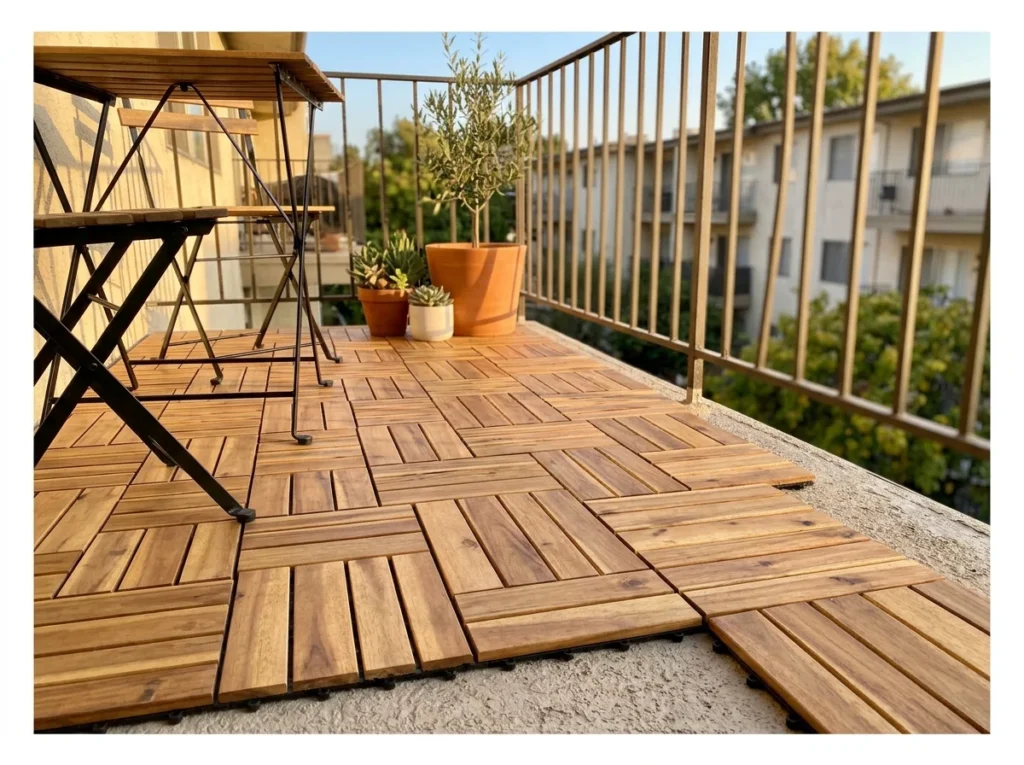
Interlocking deck tiles snap together directly over existing concrete or tile flooring, instantly transforming the most neglected surface on any balcony without adhesives, grout, or any permanent modification. The difference between bare concrete and warm timber underfoot is dramatic.
Natural timber tiles, composite wood-look options, and slate-effect porcelain tiles all work beautifully. The installation takes under an hour, and the tiles lift flat for transport to a new home, making this ideal for renters and homeowners alike.
Budget-friendly option that creates the biggest visible transformation.
Railing Planter Box Garden
A railing planter box attaches directly to the balcony railing, adding greenery without taking up floor space. This setup works especially well for herbs, small flowers, or trailing plants that do not need much room to grow. It is one of the easiest ways to add a garden feel to a space with very little square footage.
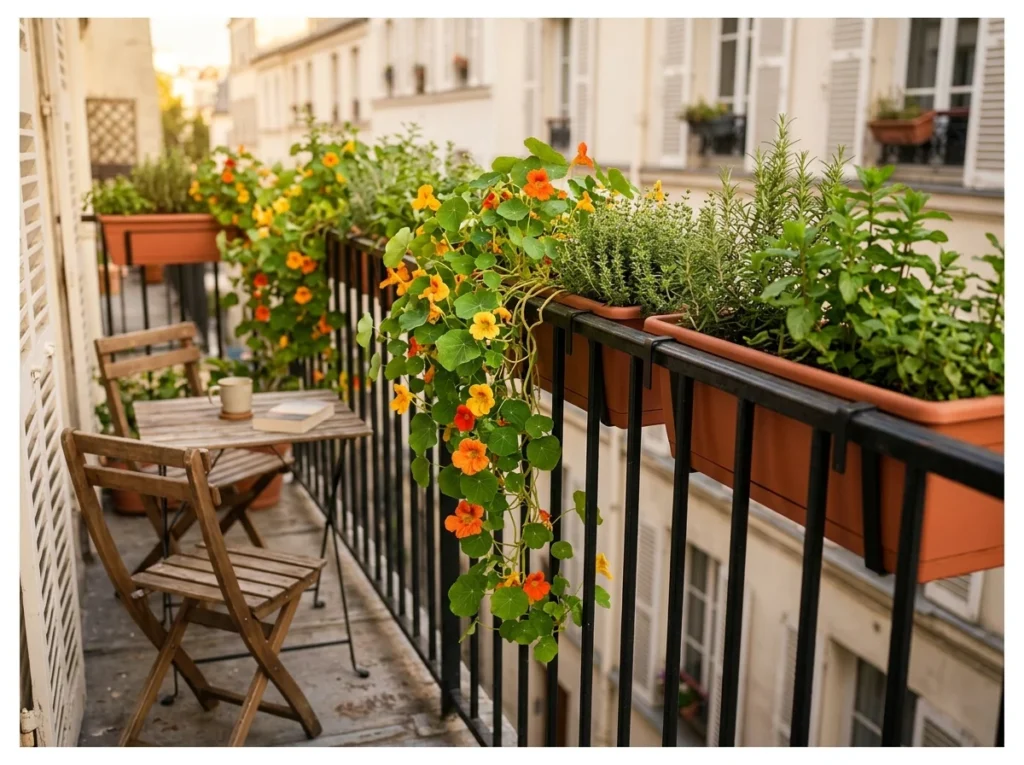
Railing-mounted planters clip directly onto the balcony’s top rail, creating an entire planting zone at railing height that requires zero floor footprint. The trailing growth cascades downward while the upright varieties reach upward, maximizing the vertical space.
Choose lightweight planters with drainage holes and secure clip systems rated for the specific railing profile. Herbs, trailing nasturtiums, and compact flowering annuals all suit this elevated position and handle outdoor sun exposure well.
If you want more color alongside the herbs, blooms that thrive in a small space has plenty of options worth adding to the mix.
Slim Folding Table and Chair Set
A slim folding table and chair set can be packed away completely when the balcony needs to be cleared. This flexibility matters a lot in small spaces that need to serve more than one purpose. When not folded up, it still offers enough room for a quick meal or morning coffee.
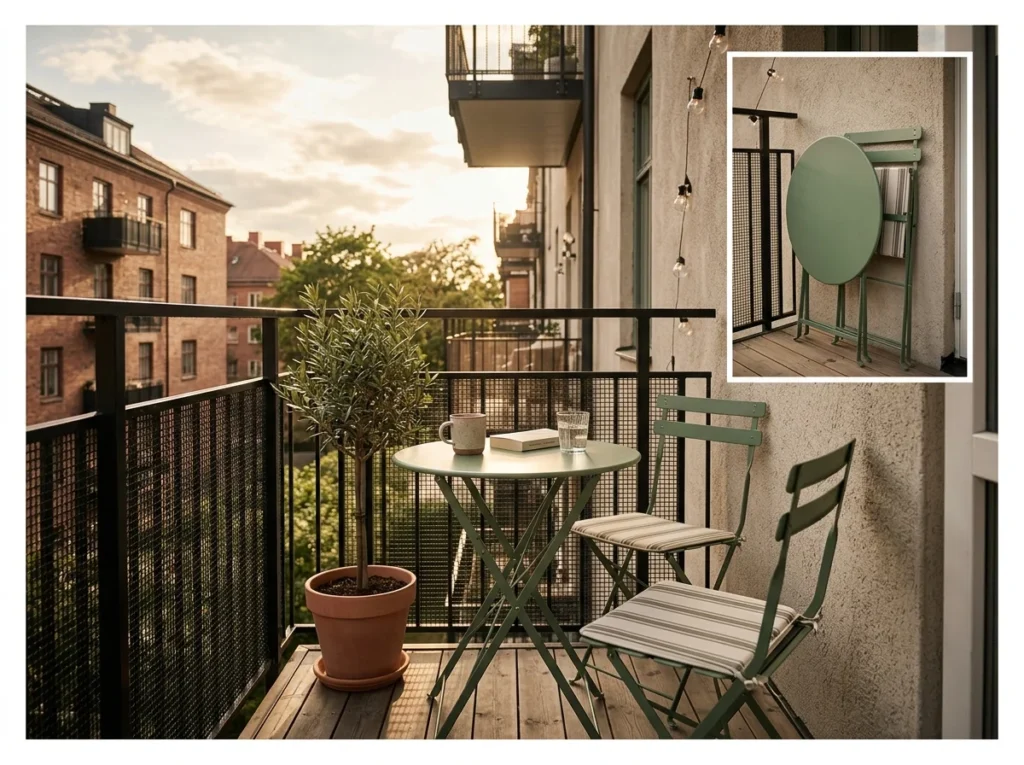
A slim folding table paired with matching folding chairs delivers genuine dining and working function in a footprint that collapses entirely against a wall when the balcony needs to serve a different purpose. The set appears and disappears on demand.
This flexibility suits balconies that double as laundry air-drying space, exercise areas, or simply need clearance for access. Quality folding furniture in weather-resistant aluminum or steel handles outdoor exposure reliably without the bulk of conventional patio sets.
If cooking outside is part of the plan too, a grill sized for a tight footprint shows how to fit that in without sacrificing space.
Vertical Succulent or Plant Panel
A vertical succulent or plant panel mounts directly onto a wall, letting greenery grow upward instead of outward. Succulents work particularly well here since they need minimal soil depth and very little watering. This setup is one of the most space efficient ways to bring plants into a tiny balcony.
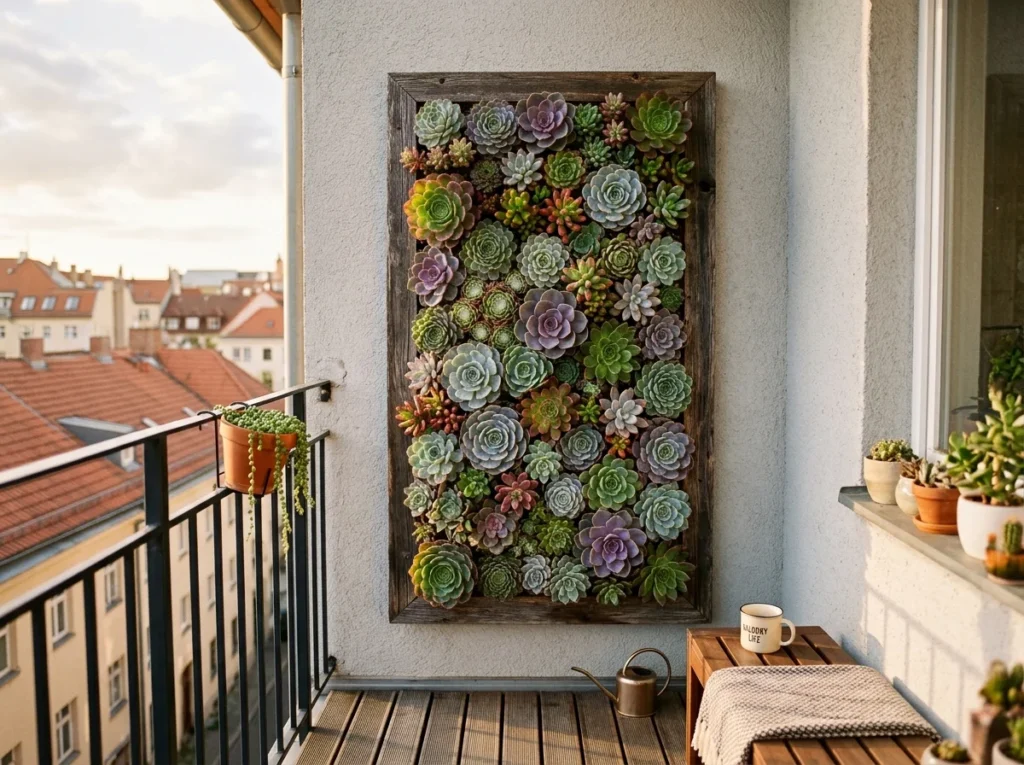
A vertical living plant panel mounts flat against the balcony wall, holding dozens of succulents or small flowering plants in a grid arrangement that functions simultaneously as living art and genuine garden. The entire installation occupies wall space that would otherwise remain blank.
Succulent panels suit sunny balconies with minimal watering requirements, while vertical felt pocket systems suit shadier positions with moisture-tolerant varieties. Both approaches transform a plain exterior wall into the balcony’s most striking visual feature.
The most impactful zero-footprint green feature available.
String Light Canopy
A string light canopy strung overhead instantly makes a small balcony feel more finished once evening arrives. Lights can be attached to hooks along the walls or a railing without needing any major installation. Warm white bulbs tend to create a cozier glow than brighter, cooler toned lights.
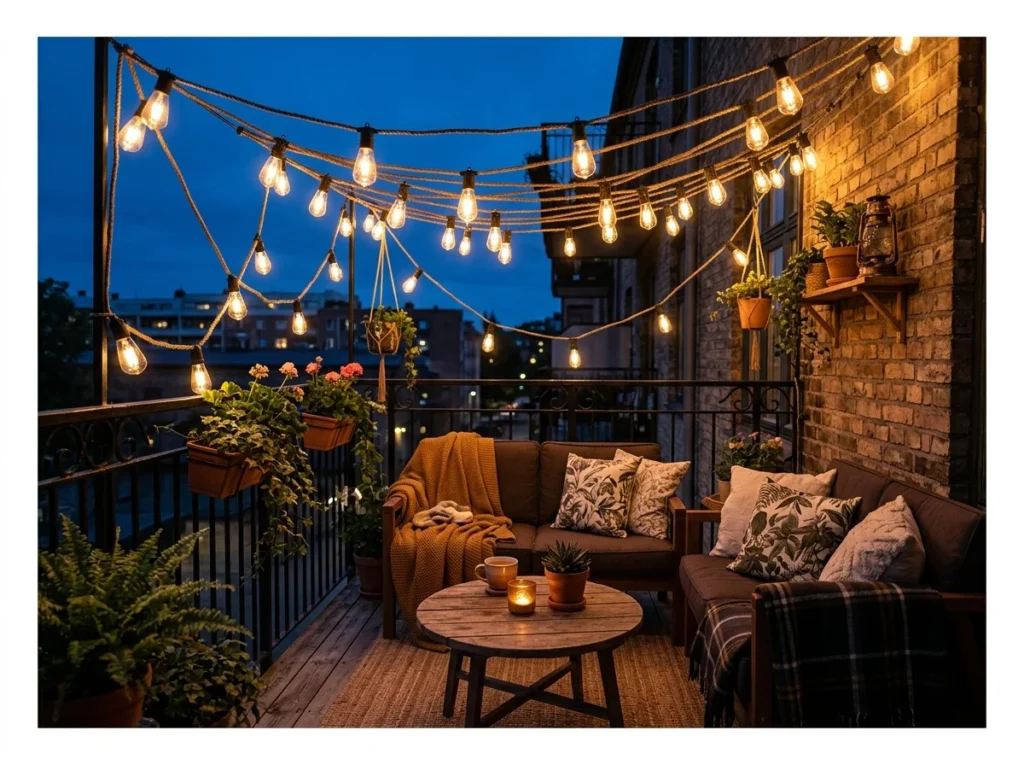
Stringing lights in a crisscross pattern between the railing’s opposing corners creates an overhead canopy of warm light that fills the small balcony’s airspace above the seating without taking up any floor area at all.
Solar-powered strings that activate automatically at dusk require no outlet and no daily management. Even a balcony measuring barely 2 square meters feels genuinely atmospheric and complete once this single layer of evening light is in place.
Compact Corner Bench with Storage
A compact corner bench with storage combines seating and a place to stash cushions or gardening tools underneath. This dual purpose design saves space compared to having separate seating and a storage box. It works especially well tucked into an unused corner that would otherwise sit empty.
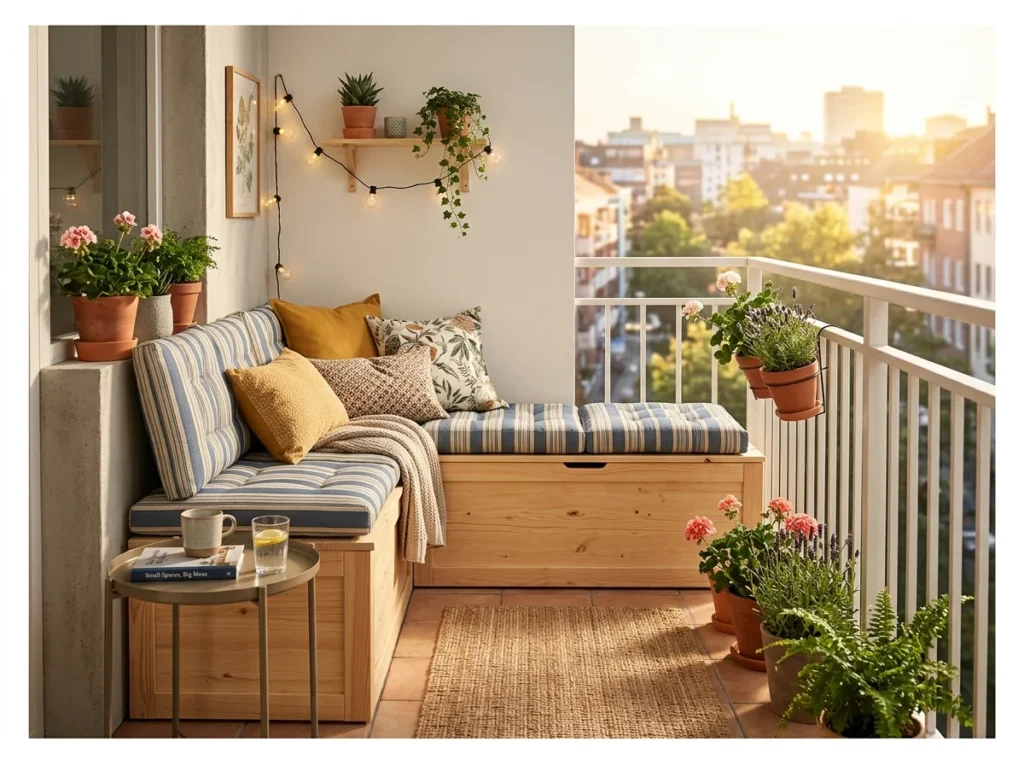
An L-shaped corner bench with a hinged storage lid positions seating precisely in the corner zone, the most awkward and underused area of any small balcony, while providing hidden storage for cushions, tools, and off-season items simultaneously.
This dual function is essential in small-space design where every object must justify its footprint with more than one purpose. The corner placement also preserves the majority of the balcony’s central area for movement and other uses.
Hammock Chair from Ceiling Hook
A hammock chair hung from a single ceiling hook takes up almost no floor space when compared to a regular chair. Its gentle swaying motion also makes it one of the more relaxing seating options for a small outdoor space. A sturdy mounting point is essential here since the hook needs to support the full weight of the chair and person.
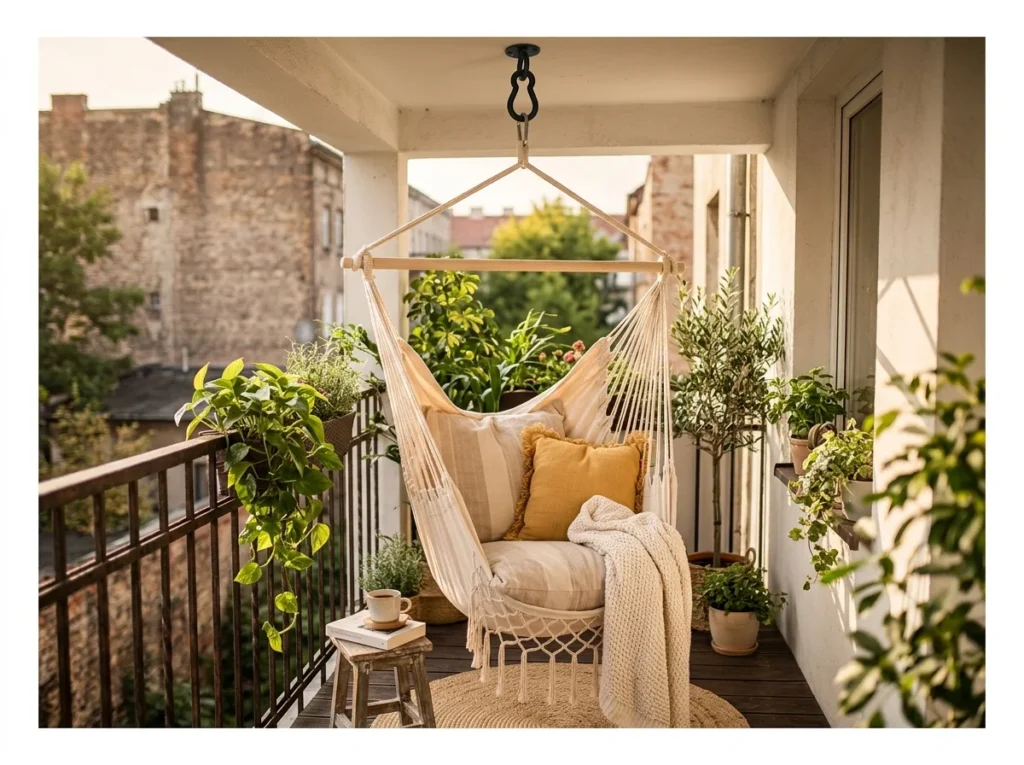
A hammock chair suspended from a single ceiling hook creates genuinely comfortable seating with a floor footprint smaller than a dinner plate. Only the anchor point needs structural confirmation, and the rest of the space remains completely free beneath the hanging chair.
This suits balconies too narrow for any conventional seating but with adequate ceiling height and structural support above. The gentle sway creates a restful quality that makes a tiny outdoor space feel like a genuine personal sanctuary.
Perfect for balconies too narrow for any standard chair.
Privacy Bamboo Screen
A privacy bamboo screen blocks the view from neighbors or a busy street without needing a solid wall. It can be attached directly to a railing, which keeps it from taking up any actual floor space. This addition turns an otherwise exposed balcony into a more secluded corner.
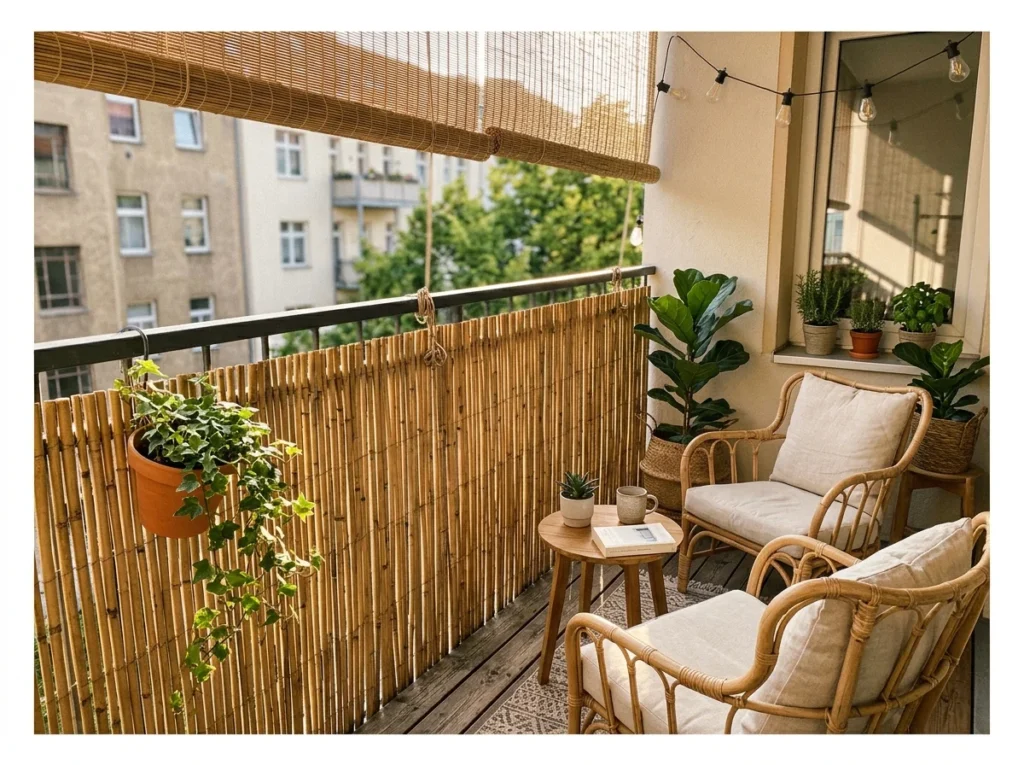
A roll-out bamboo privacy screen attached to the existing railing blocks direct sightlines from neighboring balconies and street level without requiring permanent installation. It rolls up for storage and repositions easily as needed.
Privacy screening transforms how a small balcony is actually used. Without it, many people avoid sitting outside because they feel exposed. With it, the space becomes genuinely restful and personal regardless of how close neighboring properties sit.
For a broader look at making the most of a compact outdoor space like this, a full apartment approach to small spaces is worth exploring.
Outdoor Rug for Zone Definition
An outdoor rug helps mark out a specific seating area on an open balcony or patio. Even a small rug can make a corner feel like an actual room rather than leftover space. Weather resistant materials are worth choosing since the rug stays exposed to sun and rain.
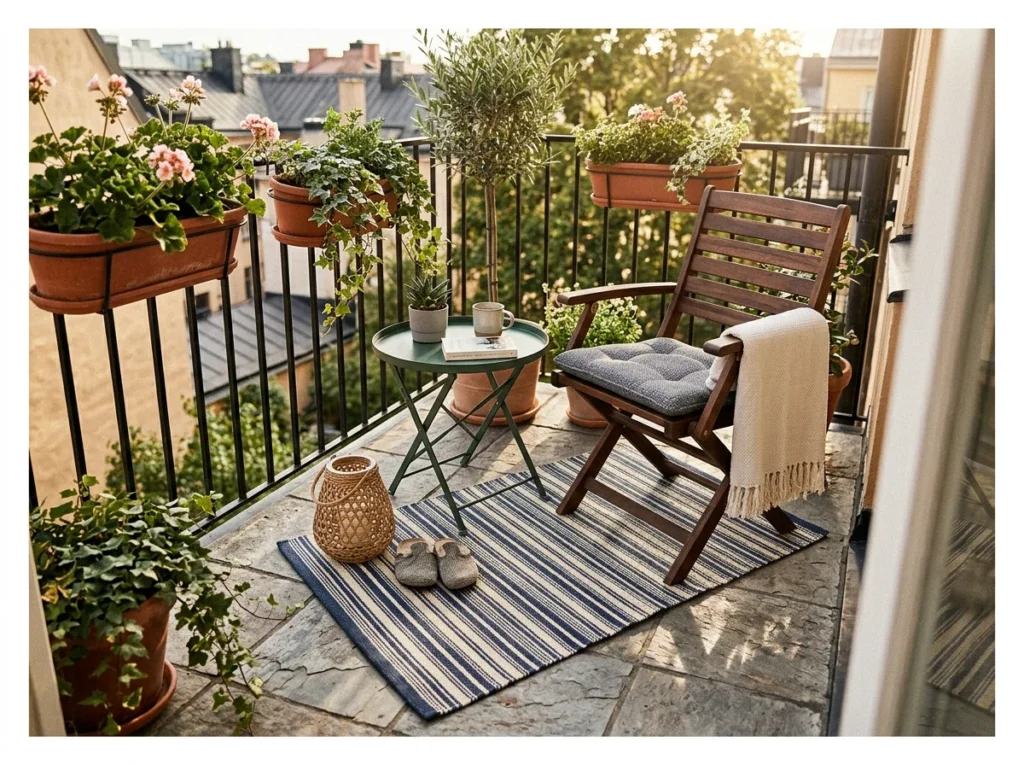
A small outdoor rug placed beneath the main seating area signals a deliberate outdoor room rather than simply a concrete ledge outside a sliding door. The defined zone makes even the smallest balcony feel intentional and designed.
Choose a weatherproof synthetic rug sized to fit under the furniture footprint rather than attempting to cover the entire floor. A simple geometric stripe or solid neutral suits most balcony furniture palettes without competing visually with surrounding plants.
Wall-Mounted Herb Garden
A wall mounted herb garden keeps fresh basil, mint, or rosemary within easy reach of the kitchen. This setup frees up the entire floor for seating or other furniture instead of pots sitting around. It is practical as well as decorative, since the herbs actually get used in cooking.
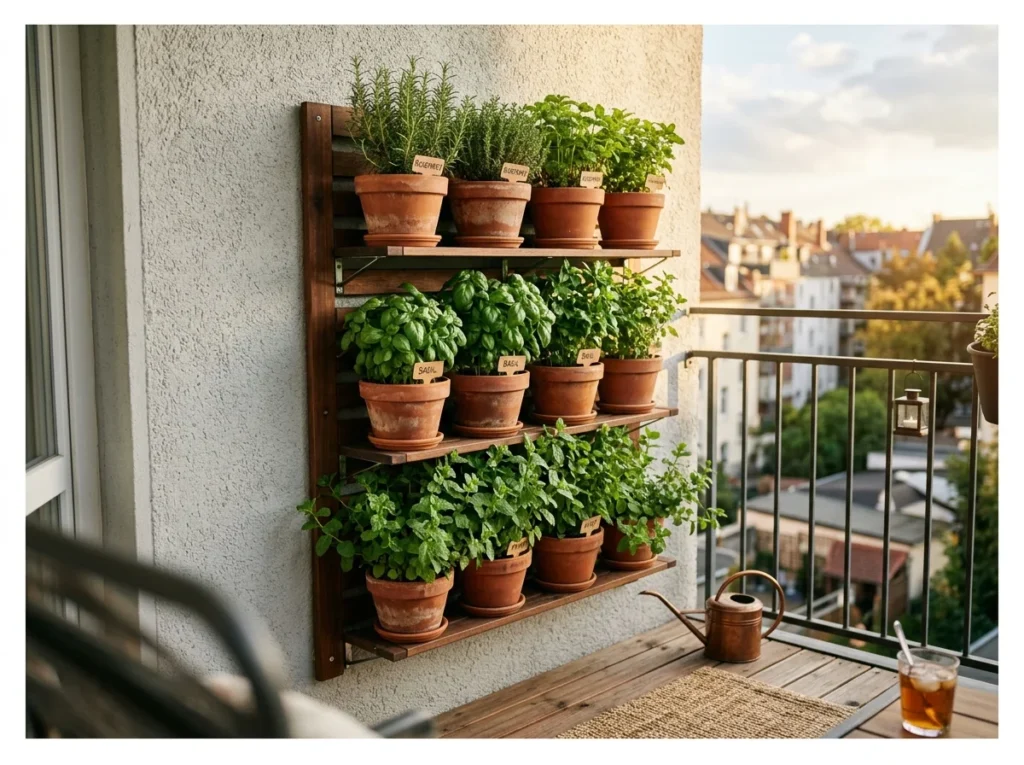
A wall-mounted herb garden delivers fresh cooking herbs directly from the balcony to the kitchen while consuming no floor space whatsoever. Brackets, tension-rod systems, and pegboard-style mounts all suit different balcony wall materials and lease restrictions.
Rosemary, thyme, mint, and basil all grow well in small containers mounted at wall height when receiving adequate sunlight. This approach gives a small balcony genuine purpose and daily usefulness beyond simply being an outdoor sitting area.
Reflective Mirror Panel
A reflective mirror panel mounted on a balcony wall bounces light and greenery, making the space feel larger than it actually is. Weatherproof framing matters here since the mirror stays exposed to rain and humidity. This trick works especially well on narrow balconies where extra depth is hard to come by otherwise.
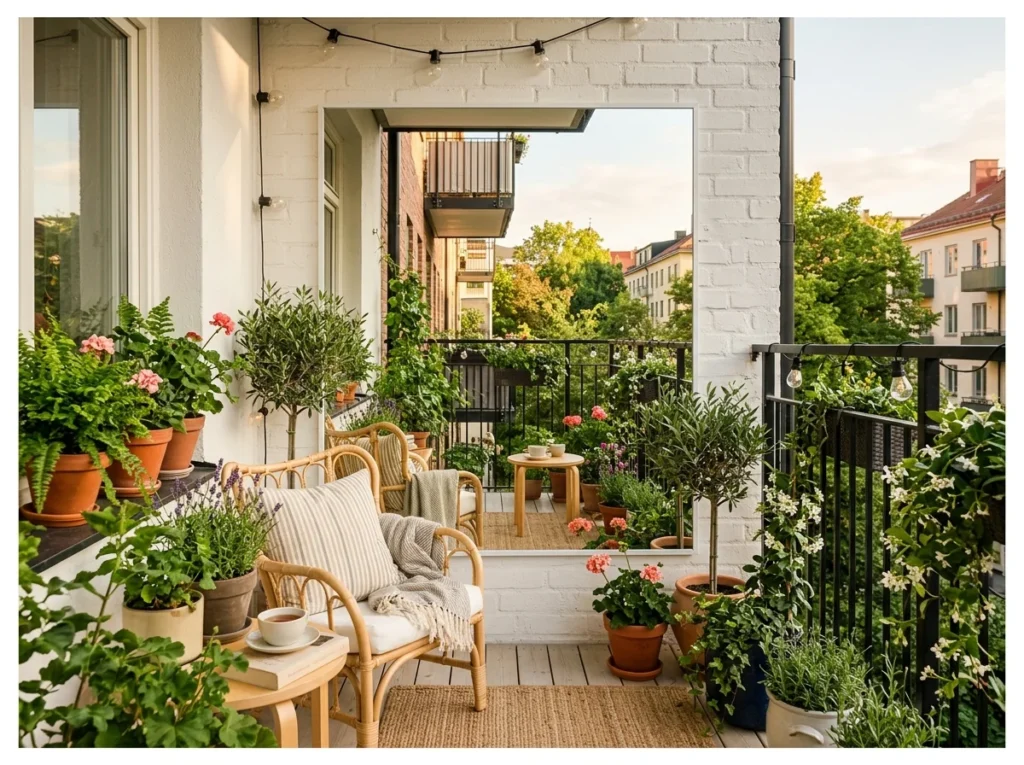
A weatherproof outdoor mirror mounted on the balcony’s most visible wall creates an illusion of doubled depth, reflecting the existing greenery and sky back into the space. The visual expansion it delivers is one of the most consistent small-space design techniques available.
Position the mirror to reflect the balcony’s most beautiful element, whether a planted railing, an adjacent green tree, or simply the open sky. This addition costs relatively little while delivering a perceptible and immediate impression of more space.
The visual trick that makes tiny feel twice as generous.
Slim Bar Table with Stools
A slim bar table paired with stools fits into balconies too narrow for a regular dining table. Its taller height also makes it easy to lean against for a quick drink or snack outdoors. Stools can usually be tucked underneath when not in use, keeping the floor area clear.
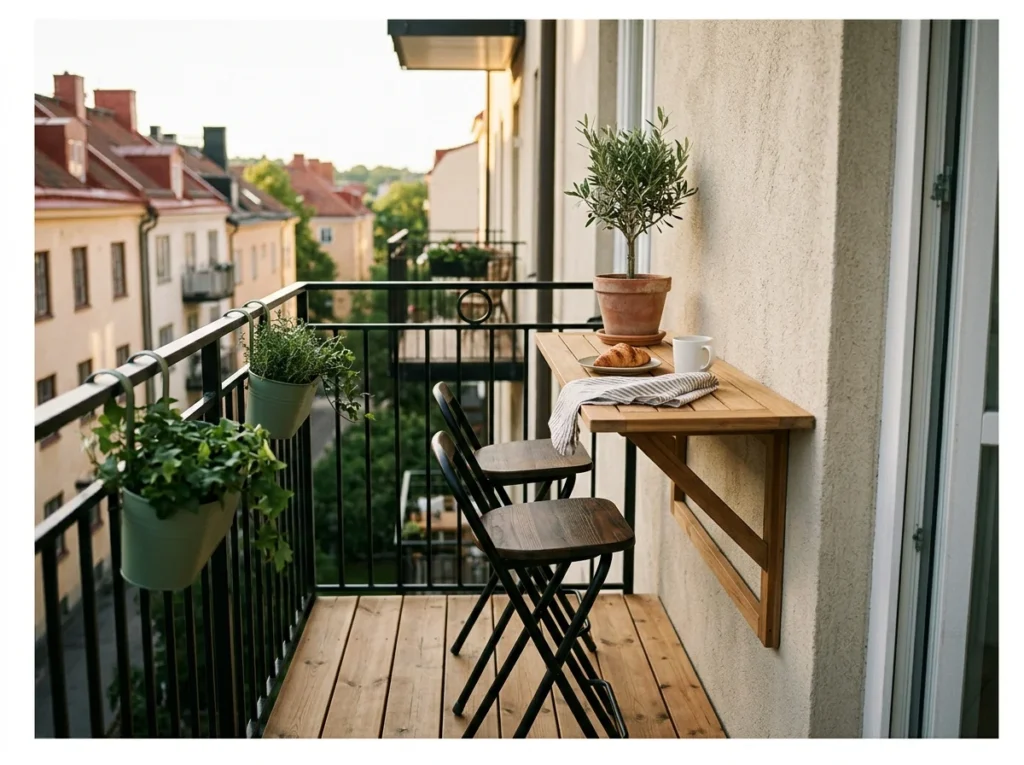
A wall-mounted bar table folds down from the balcony wall, providing a genuine dining or working surface when needed and disappearing entirely when not. Paired with folding bar stools, this creates a complete dining setup within an extremely compact footprint.
The elevated bar height also means the table and stools require less clearance around them for comfortable use than a standard-height dining set. This configuration suits balconies narrow enough that a traditional table arrangement simply wouldn’t clear the doorway or railing comfortably.
Ceiling Fan for Summer Comfort
A ceiling fan installed on a covered balcony keeps the air moving during warmer months when the space can feel stuffy. This addition makes a real difference on humid days when there is little natural breeze. It also extends how often the balcony actually gets used throughout the summer.
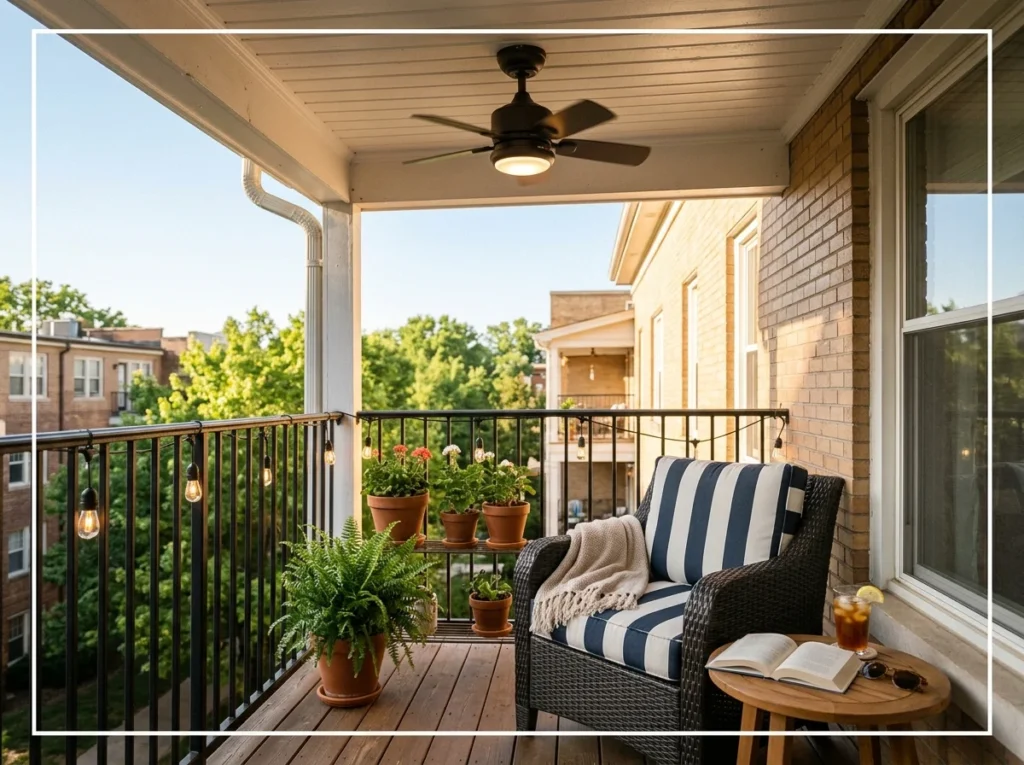
A compact ceiling fan rated for outdoor wet or damp locations provides air movement that transforms a small, covered balcony from stagnant and uncomfortable in humid summer heat to genuinely usable throughout the warmest months of the year.
This functional addition suits balconies with a solid ceiling structure and existing electrical access. Even a small 45-centimeter fan creates enough airflow to make sustained outdoor sitting comfortable in weather that would otherwise drive everyone inside.
Neutral Palette with a Bold Accent
A neutral palette with a single bold accent keeps a small balcony from feeling visually cluttered. One bright cushion, rug, or piece of decor draws the eye without overwhelming the limited space. This approach makes the balcony feel intentional rather than randomly furnished.
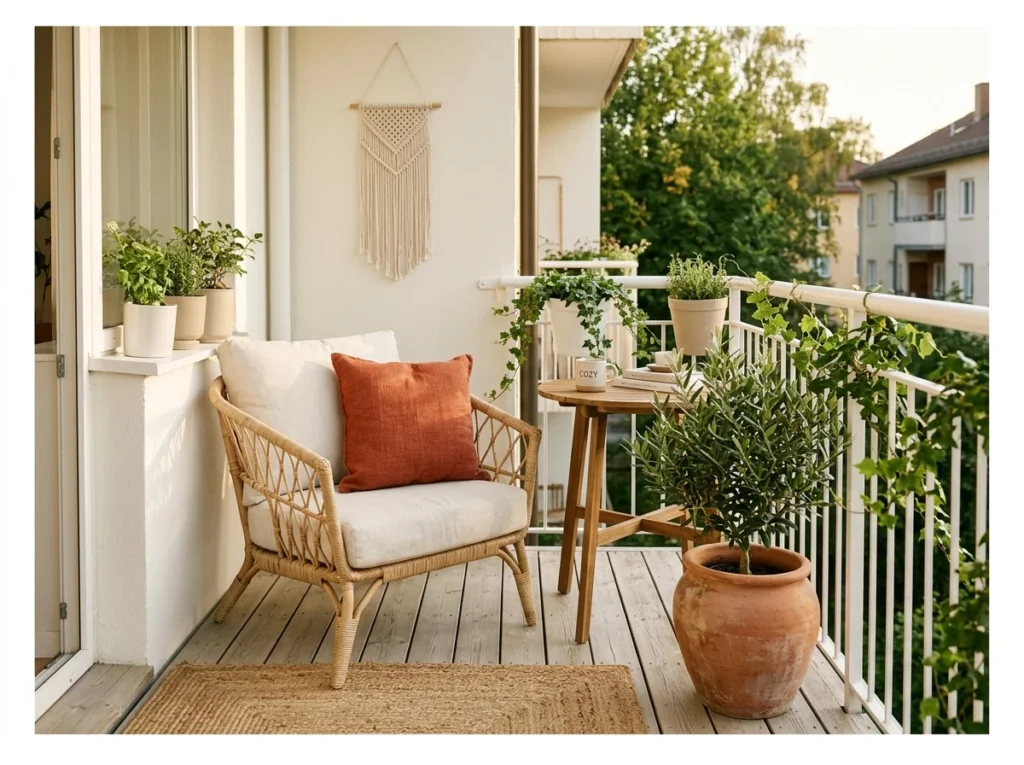
A neutral palette of white, cream, and natural timber across the main surfaces of a small balcony prevents visual fragmentation that competing colors create in tight spaces. One deliberately chosen accent color, introduced in cushions or a single planter, adds personality without chaos.
This design approach borrows directly from professional interior design principles applied to the outdoor space: limit the palette to two or three tones maximum, then let texture and form provide the variety rather than competing colors.
Potted Citrus or Olive Tree
A potted citrus or olive tree adds height and greenery without needing an in ground planting space. Both types tend to handle container growing well, provided they get enough sunlight throughout the day. This single plant can become the visual anchor of an otherwise simply furnished balcony.
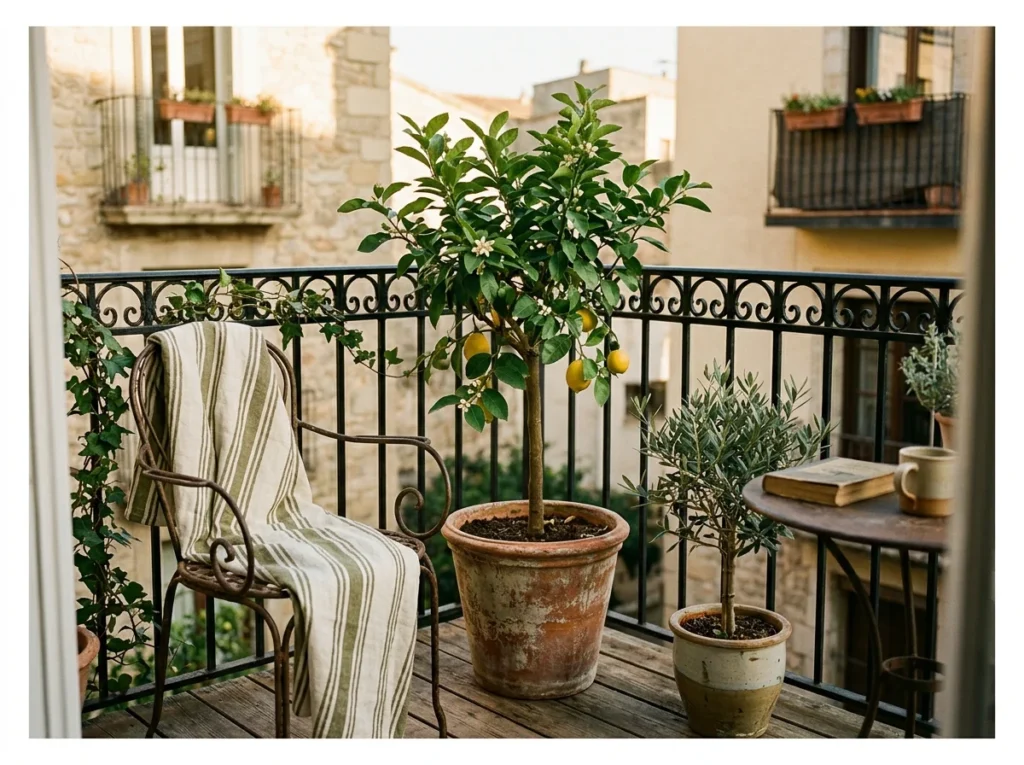
A single potted dwarf citrus or olive tree delivers more visual presence and genuine botanical character per pot than any collection of smaller plants. The structured canopy and interesting foliage create year-round garden atmosphere in a single container.
Meyer lemon, kumquat, and dwarf olive varieties all suit large terracotta pots on sunlit balconies and stay proportionally scaled for small spaces throughout their growth. Fruit production adds another sensory dimension to the balcony experience beyond purely decorative value.
If potted trees have you thinking about plants more broadly, greenery that thrives without much fuss has plenty of ideas that work well indoors too.
Wall-Mounted Folding Desk
A wall mounted folding desk gives a balcony a spot for working or writing without permanently taking up floor space. When folded flat against the wall, it barely sticks out at all. This setup works particularly well for anyone who wants an occasional outdoor workspace in a tight footprint.
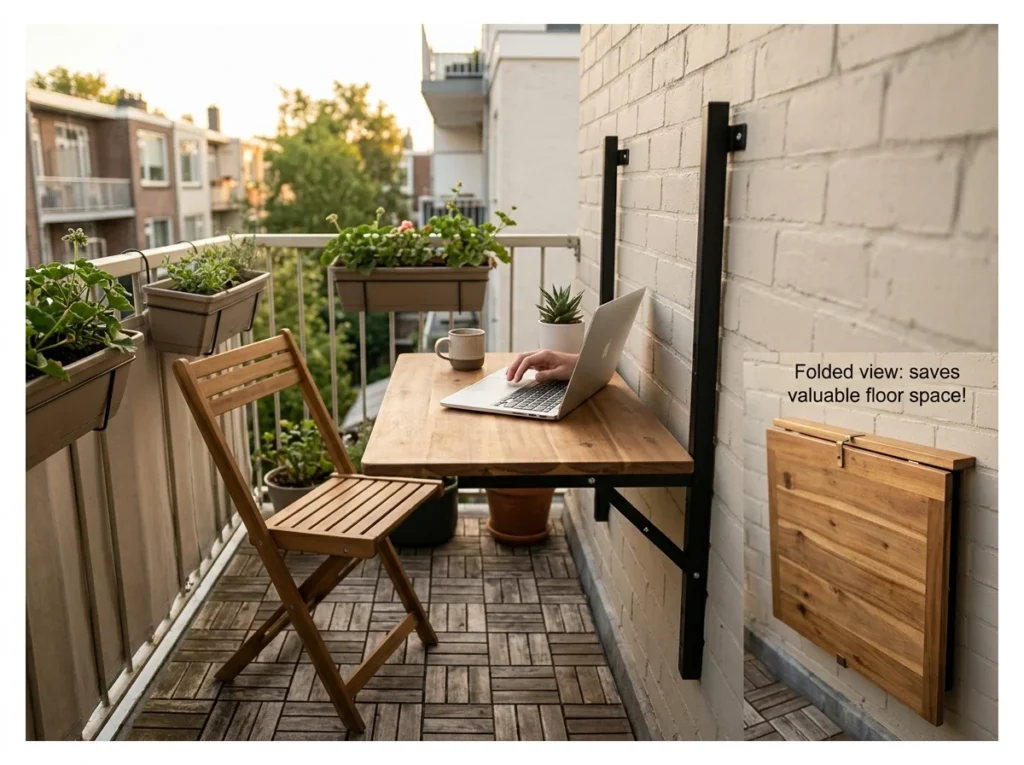
A wall-mounted folding desk extends outward for outdoor working sessions and folds back to near-zero depth against the wall when the balcony is needed for other purposes. This is particularly valuable in homes where dedicated indoor workspace is limited.
Working outdoors with fresh air and natural light genuinely improves focus and wellbeing. Even a 60-centimeter-wide desk creates adequate workspace for a laptop and notebook while consuming minimal footprint in an extended position.
Layered Lighting at Multiple Heights
Layered lighting at multiple heights combines string lights, lanterns, and small table lamps instead of relying on one single source. This approach helps a small balcony feel warmer and more dimensional once it gets dark. Different lighting layers can also be adjusted depending on whether the space is being used for relaxing or entertaining.
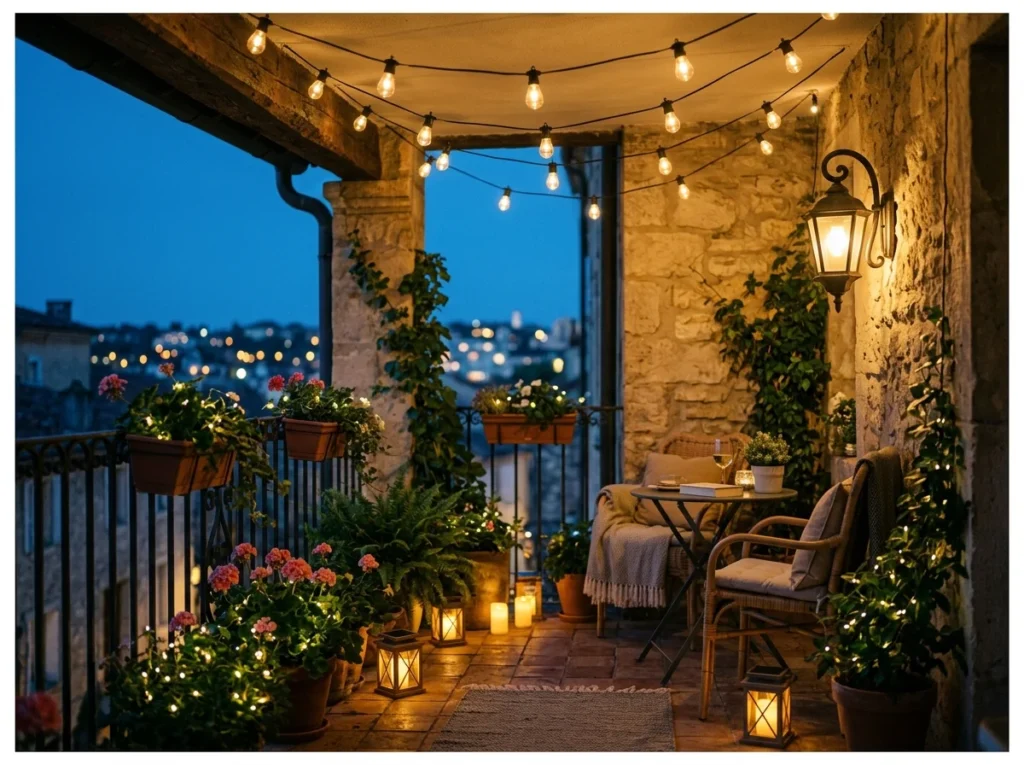
Combining overhead string lights, a wall-mounted sconce, and ground-level solar lanterns creates layered illumination at three distinct heights, transforming a small balcony from a daytime-only space into a genuine evening destination with real atmospheric depth.
This approach mirrors professional interior lighting design principles applied to outdoor space. Each light layer serves a different function, ambient overhead light, directional task light, and accent floor lighting, and together they create a richness that no single fixture achieves alone.
Trailing Vine Along the Railing
A trailing vine grown along the balcony railing adds greenery that spreads horizontally rather than taking up floor space. Ivy or string of pearls are common choices since they drape naturally over the edge. Over a season or two, the vine fills in and softens the hard lines of the railing.
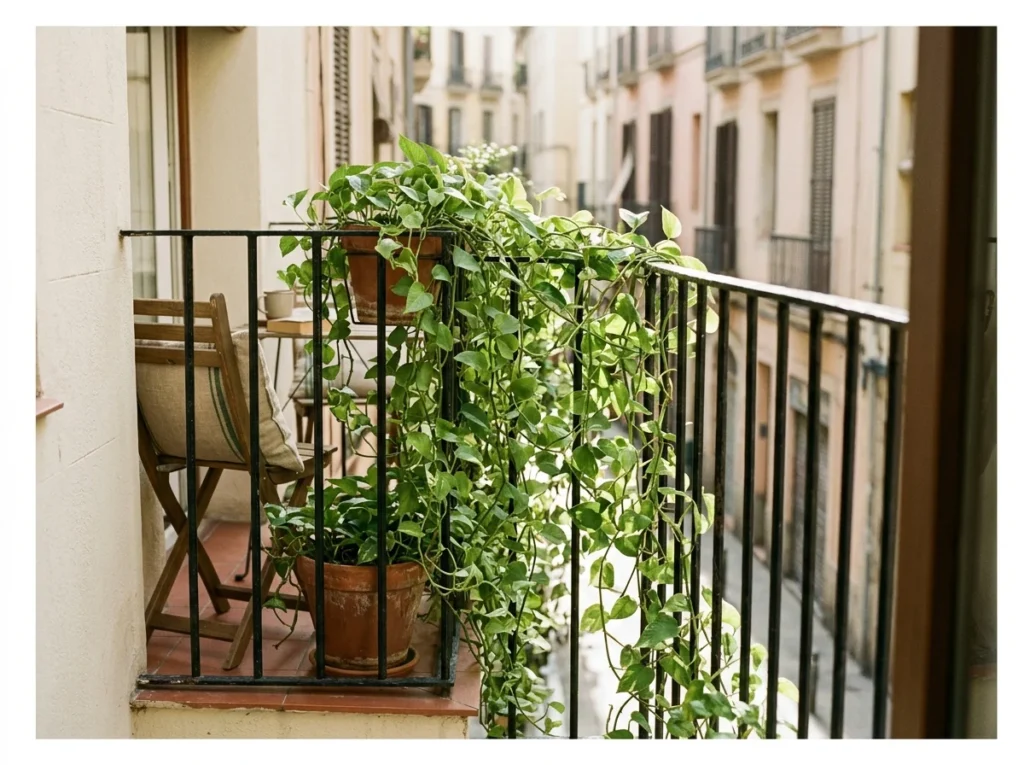
A vine planted in a railing-mounted pot trails its growth downward through the bar gaps over time, creating a soft living curtain that transforms the railing from a hard, industrial barrier into a genuinely organic green feature.
This takes patience, since the vine needs several growing seasons to fill in significantly, but the seasonal payoff is a balcony that becomes more beautiful with every year rather than remaining static. Pothos and English ivy both grow reliably in this railing trailing application.
Natural, low-cost, and more beautiful every season.
Modular Seating Cubes
Modular seating cubes can be rearranged into different configurations depending on how many people are visiting. They can be pushed together for a coffee table or spread apart for extra individual seats. This flexibility makes them a practical choice for a balcony that needs to adapt to different uses.
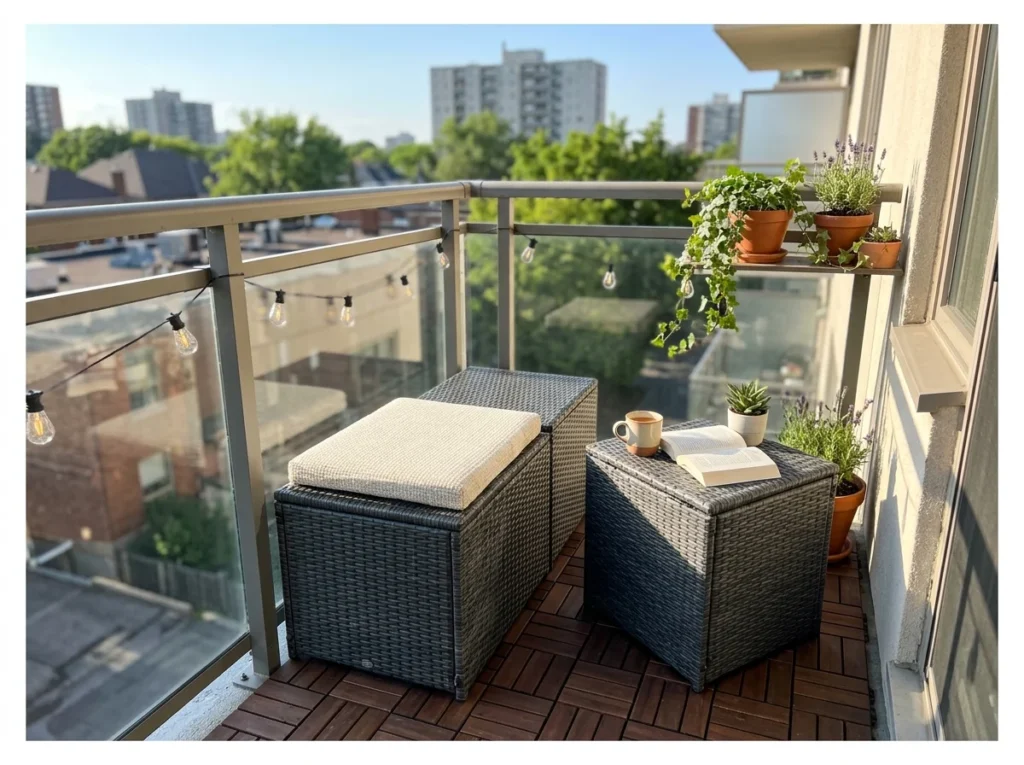
Weatherproof storage cubes serve simultaneously as seating, footrests, side tables, and hidden storage depending on arrangement and need. Two or three cubes reconfigure in minutes to suit a solo reading session, a two-person dinner, or a clear floor for morning stretching.
This multi-role flexibility is exactly the small-space design principle that distinguishes genuinely functional compact balconies from ones that look nice in photographs but fail in daily use. The storage interior also keeps cushions and supplies dry and accessible.
Compact Lounge Daybed
A compact lounge daybed is built wide enough to stretch out on despite the limited footprint of a small balcony. It works well for reading or relaxing in the sun during a quiet afternoon. Some versions fold or convert into regular seating when more space is needed.
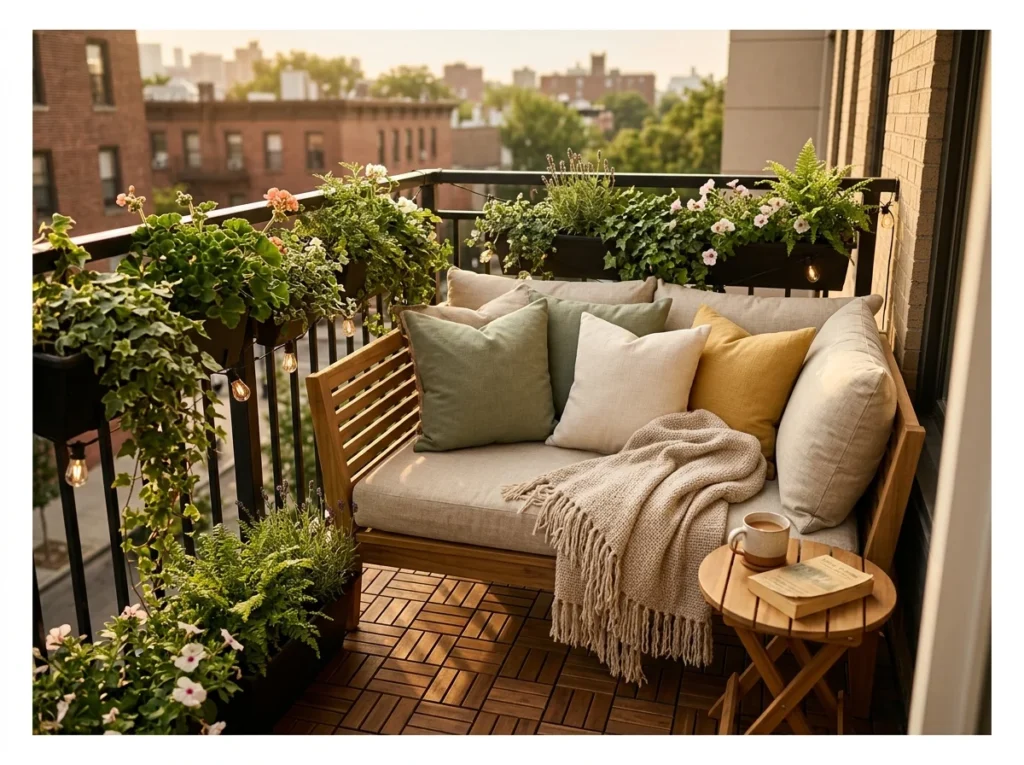
A compact daybed sized specifically for a small balcony’s constraints provides a genuinely reclined lounging position rather than forcing fully upright seating. Even a narrow 60-by-150-centimeter daybed delivers complete full-body relaxation that a conventional chair cannot.
Position it against the longest wall to minimize its footprint within the balcony. This single furniture choice often becomes the most used and most valued element in a well-designed small outdoor space precisely because genuine physical comfort is so rare in these compact areas.
Solar Lantern Display
A solar lantern display adds a soft glow to a small balcony without needing any wiring. Lanterns charge during the day and switch on automatically once it gets dark outside. Grouped together at different heights, they create a warm ambiance after sunset.
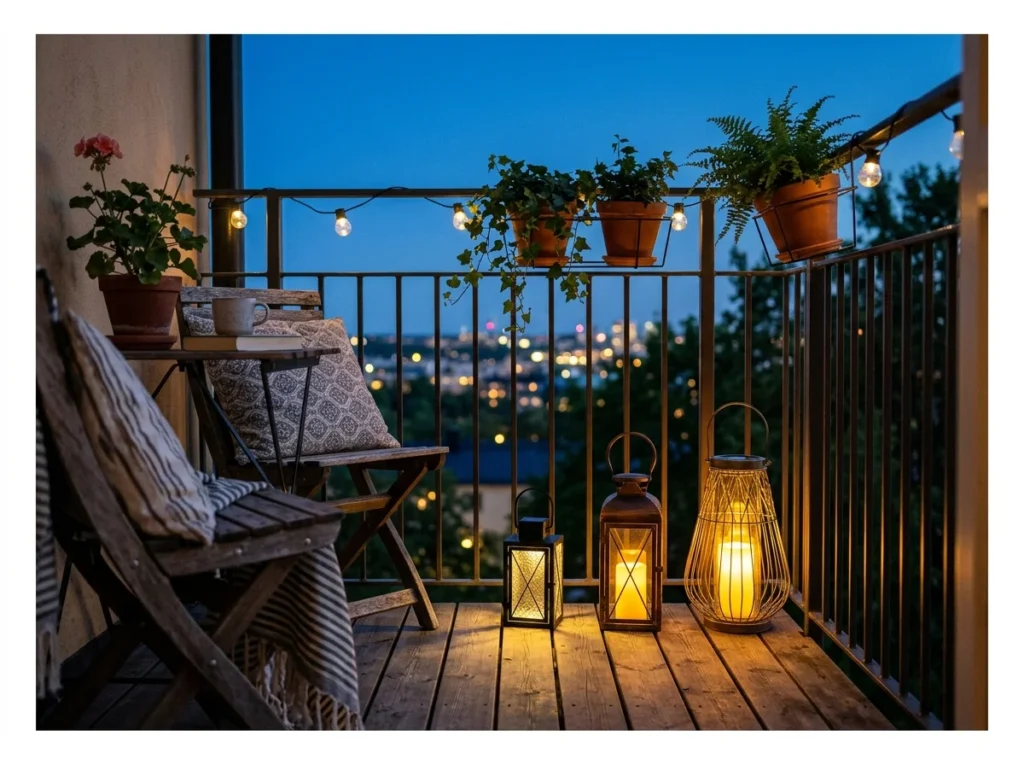
Three solar lanterns at varied heights positioned along the floor edge or railing ledge create a composed evening light display that activates automatically each night, requires zero wiring, and costs nothing to run after the initial purchase.
Grouping lanterns at different heights creates visual rhythm and dimensionality that a row of identical fixtures at the same height cannot achieve. This simple evening addition is genuinely one of the most impactful low-effort small balcony improvements available.
Weather-Resistant Curtains
Weather resistant curtains hung along the open edge of a balcony offer privacy that can be drawn shut or pulled back as needed. Heavier outdoor fabric holds up better against wind and moisture than lighter indoor curtains would. This addition also softens the look of a balcony that would otherwise feel fully exposed.
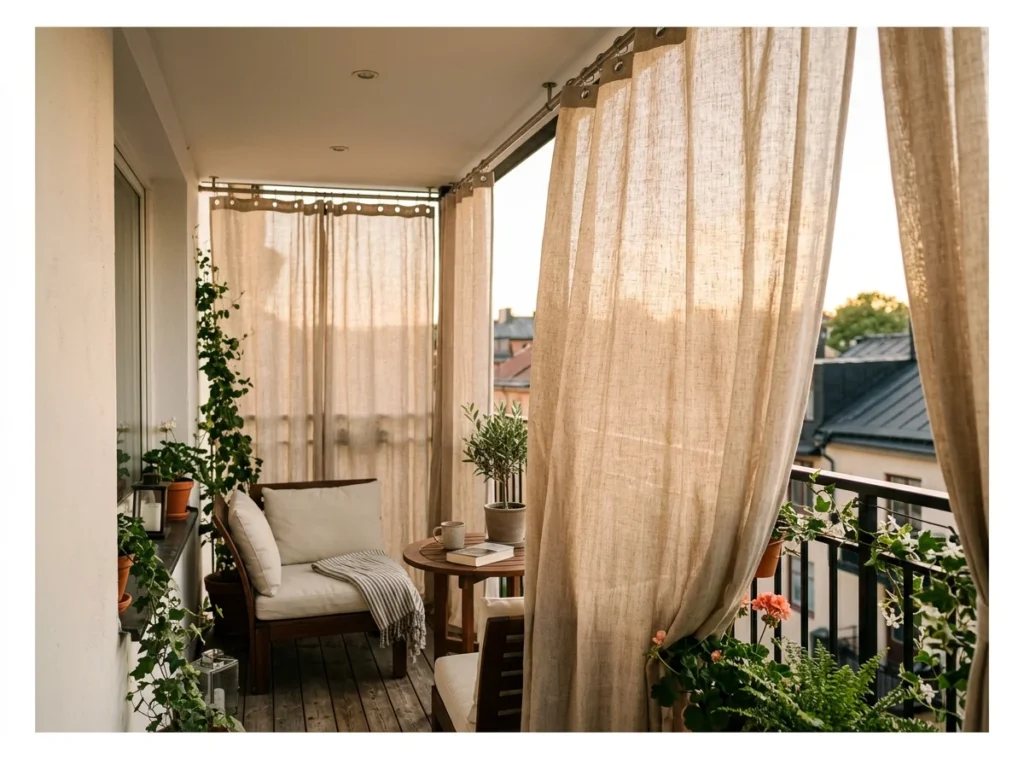
Weather-resistant curtains hung from a tension rod or ceiling track create adjustable shade and privacy from neighboring views without requiring a permanent shade sail or solid screen structure. Drawing them partially closed during peak sun makes a small balcony genuinely comfortable on hot afternoons.
Heavyweight outdoor linen or synthetic performance fabrics handle UV exposure and occasional rain without fading or deteriorating quickly. The soft fabric also adds genuine visual warmth that hard privacy screens and shade sails lack.
For more ways to carve out a private corner like this, a privacy solution worth studying covers the idea in more depth.
Single Material Palette Throughout
A single material palette throughout the balcony keeps furniture, planters, and decor feeling cohesive rather than mismatched. Sticking to one main material, like natural wood or black metal, ties everything together visually. This approach makes even a small, tightly packed space feel more intentional and put together.
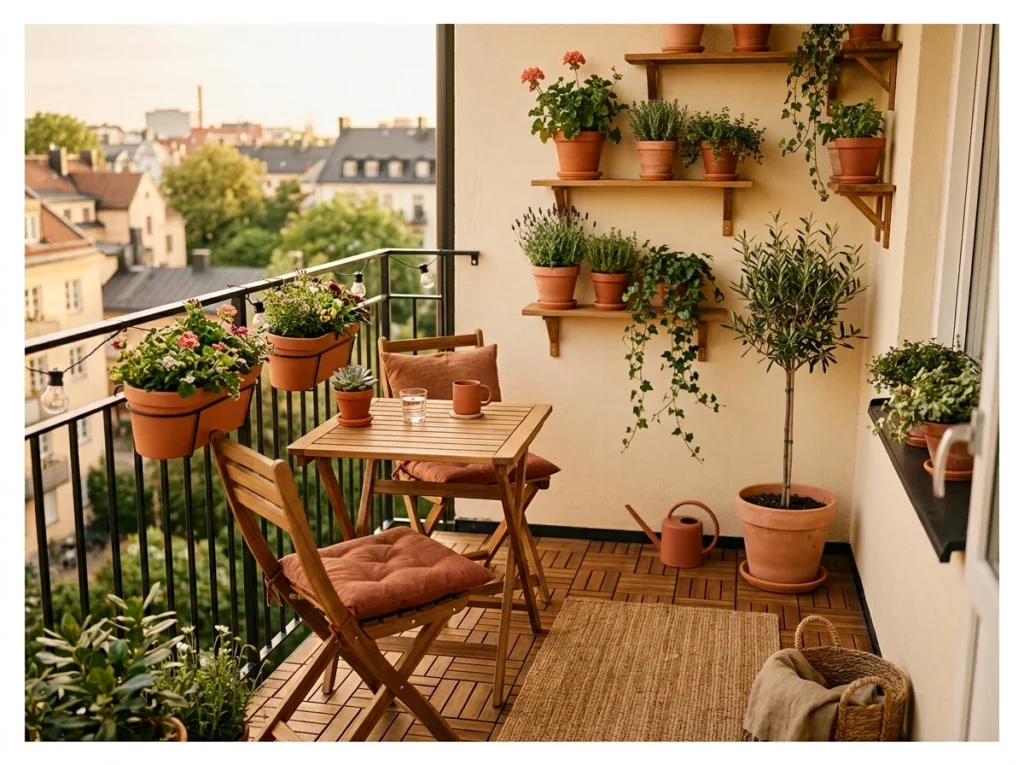
Committing to a single material palette across every element of a small balcony, natural timber, terracotta, and warm metal for example, creates visual cohesion that makes the limited space feel considered and complete rather than cluttered and busy.
When every object belongs to the same material family, the eye reads the space as a unified composition rather than a collection of separate objects competing for attention. This design discipline requires restraint but delivers a small balcony that looks genuinely intentional from the first glance.
The design discipline that makes small look completely curated.
Conclusion
A small balcony approached with genuine design intention consistently outperforms larger outdoor spaces decorated without thought. The constraint itself forces prioritization, and prioritization is what makes design genuinely good.
Start with the floor, since it is the first thing you see when stepping outside. Add one vertical plant element. Install a light source for evening use. Choose seating that either folds or stores. Everything else follows naturally from those four foundations.
The small balcony you have been underestimating is one weekend of considered decisions away from becoming the outdoor space you genuinely want to spend time in every day.
And if you have a bit more ground-level space to work with too, a backyard approach to the same discipline shows how these same principles scale up.