A messy pantry isn’t a space problem it’s an organization problem, and the right storage tricks can fix it in a weekend. These 16 kitchen pantry storage ideas use clever shelving, labeled bins, and smart layouts to help you fit more in less space without ever feeling crammed. Here are the best kitchen pantry storage ideas to max out your space!
If you’re rethinking the whole setup, there are smarter cabinet layouts to browse for more inspiration.
Pull-Out Wooden Shelves for Deep Cabinets
Pull-out wooden shelves for deep cabinets maximize storage efficiency by making hard-to-reach areas easier to access. Their smooth sliding design keeps kitchen items organized, reduces clutter, and allows you to use every inch of cabinet space more effectively.
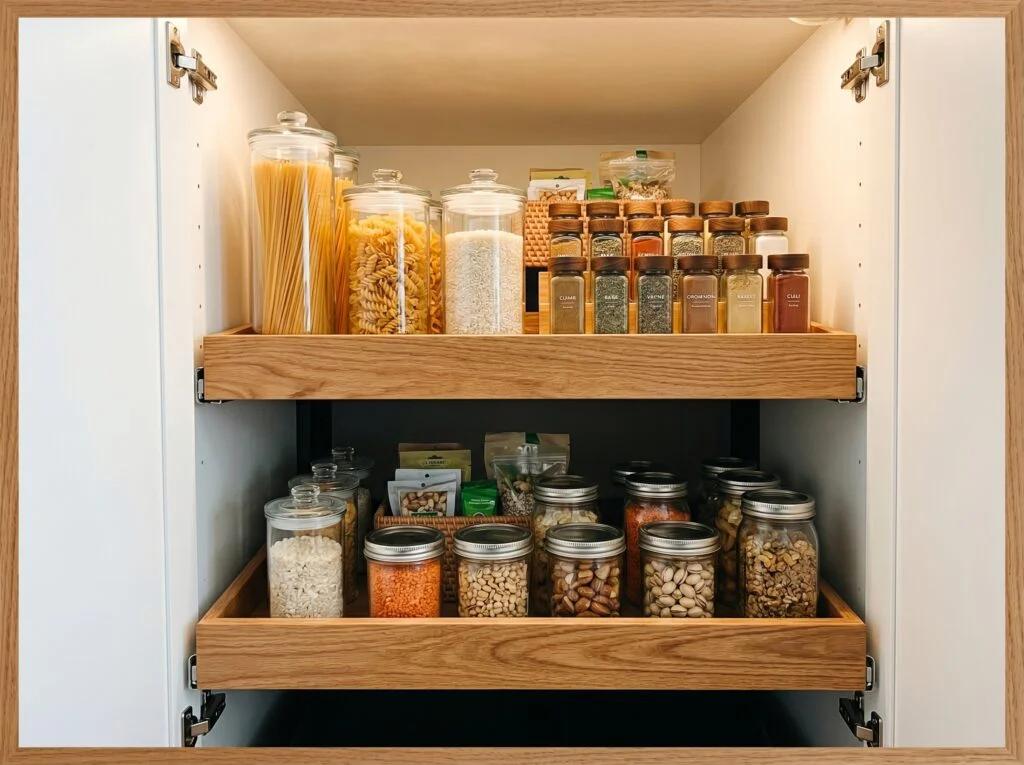
Deep pantry cabinets are one of the most common kitchen storage problems. The back 12 inches of a deep shelf becomes a black hole things go in and never come out. Pull-out wooden shelves solve this completely by bringing the entire shelf contents to you rather than making you reach and root around. A fully extended pull-out shows you everything at once, from front to back, with zero guesswork.
Installing pull-out shelves is a genuine weekend DIY project. You can buy ready-made pull-out shelf kits at IKEA, The Container Store, or Amazon for $30 to $80 per shelf, depending on size. They mount onto standard cabinet interiors with basic screws and no special tools. Measure your cabinet interior width carefully and leave about a half-inch of clearance on each side for smooth operation.
Uniform Glass Canisters for Dry Goods
Uniform glass canisters for dry goods create a clean and organized kitchen storage system while adding a stylish decorative touch. Matching containers keep ingredients visible, fresh, and easy to access while giving pantry shelves a neat, cohesive, and modern look.
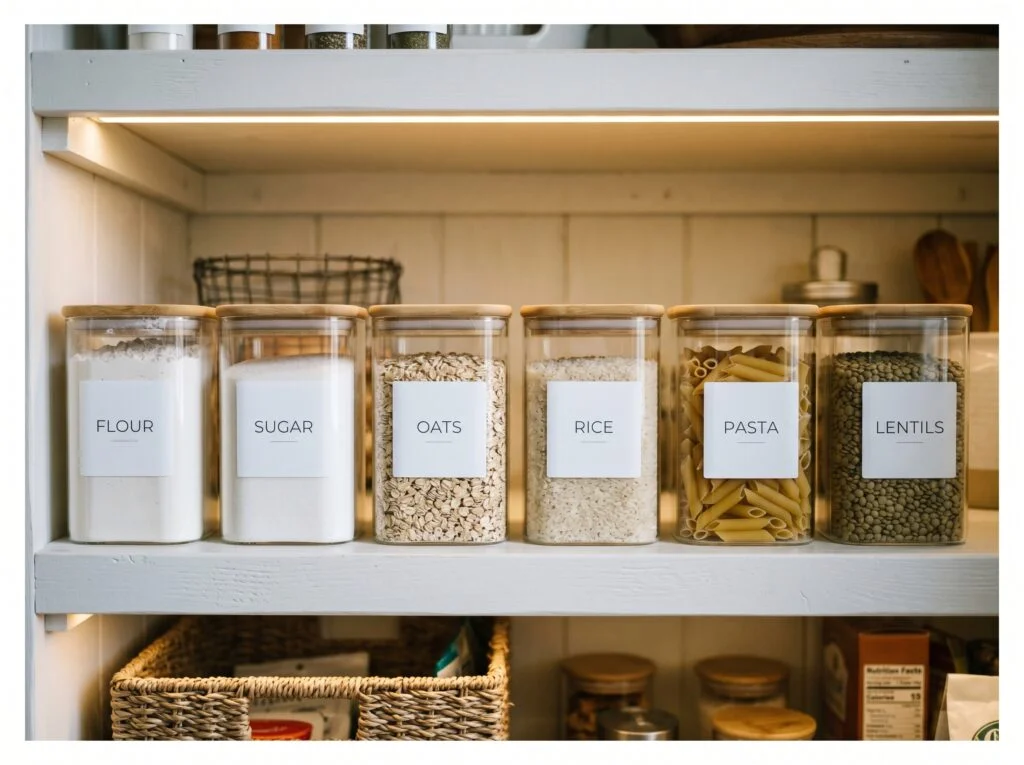
Transferring dry goods from their original packaging into uniform glass canisters is the single upgrade that transforms a pantry from cluttered to curated. Matching containers eliminate the visual chaos of mismatched bags, boxes, and half-opened packages. You can see exactly how much you have of everything at a glance, which means no more accidental double-buying at the grocery store. Glass is better than plastic for long-term storage — it doesn’t absorb odors or stains, it’s completely airtight when sealed properly, and it looks beautiful indefinitely without yellowing.
Choose a container system and stick to it mixing styles defeats the purpose. Square or rectangular containers use shelf space more efficiently than round ones because there are no wasted gaps between them. OXO Good Grips Pop containers and Anchor Hocking glass canisters are both excellent mid-range options. For a budget-friendly version, IKEA KORKEN glass jars with tight-fitting lids work extremely well.
Once the containers are sorted, a few design touches for the whole pantry can pull the space together.
Door-Mounted Spice and Condiment Organizer
A door-mounted spice and condiment organizer saves valuable kitchen space by turning unused cabinet or pantry door areas into smart storage zones. It keeps bottles, jars, and seasonings neatly arranged while making everyday cooking essentials easier to find and access.
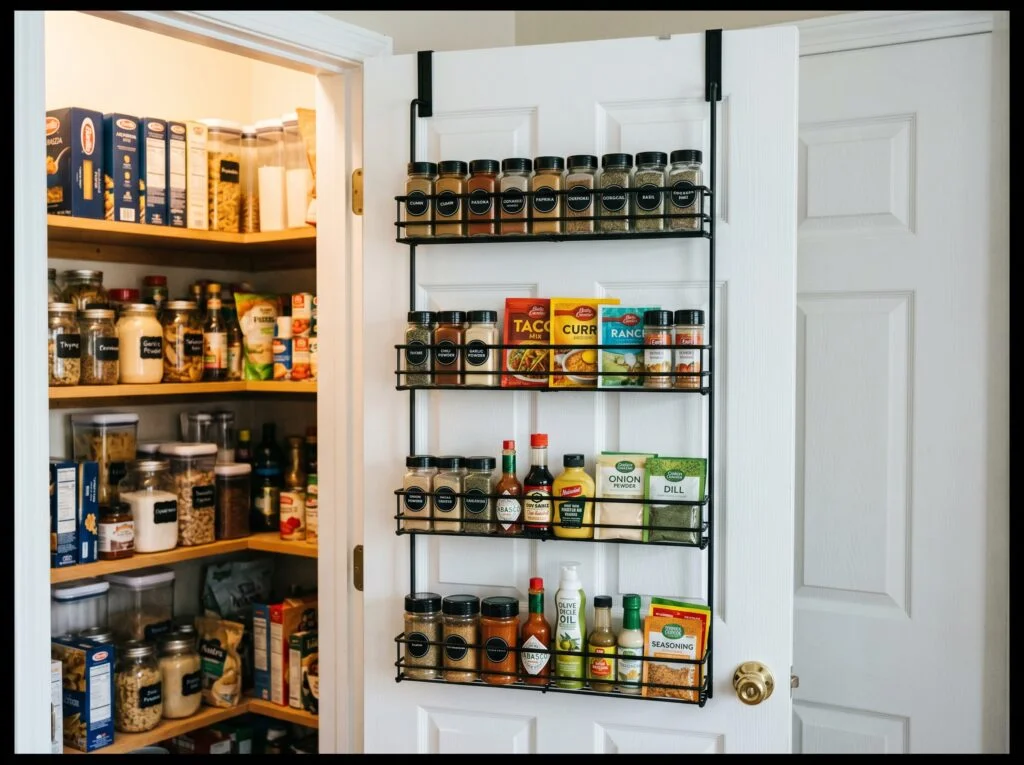
The inside of your pantry door is storage space that most people completely waste. A door-mounted organizer adds an entire extra “shelf” to your pantry without taking a single inch from your existing shelf space. This is one of the highest-return, lowest-cost upgrades available for any pantry type walk-in, cabinet, or closet.
The best over-door organizers for pantry doors use adjustable metal wire racks rather than fixed plastic shelves wire allows airflow and visibility from above, and the adjustable height means you can customize the spacing for different item sizes. Make sure your organizer is rated for the weight of what you’re storing spice jars and condiment bottles add up quickly.
Tiered Can Rack for Canned Goods
A tiered can rack for canned goods helps maximize pantry space by keeping cans organized, visible, and easy to access. The stepped design prevents items from getting lost at the back while creating a neat storage system for everyday kitchen essentials.
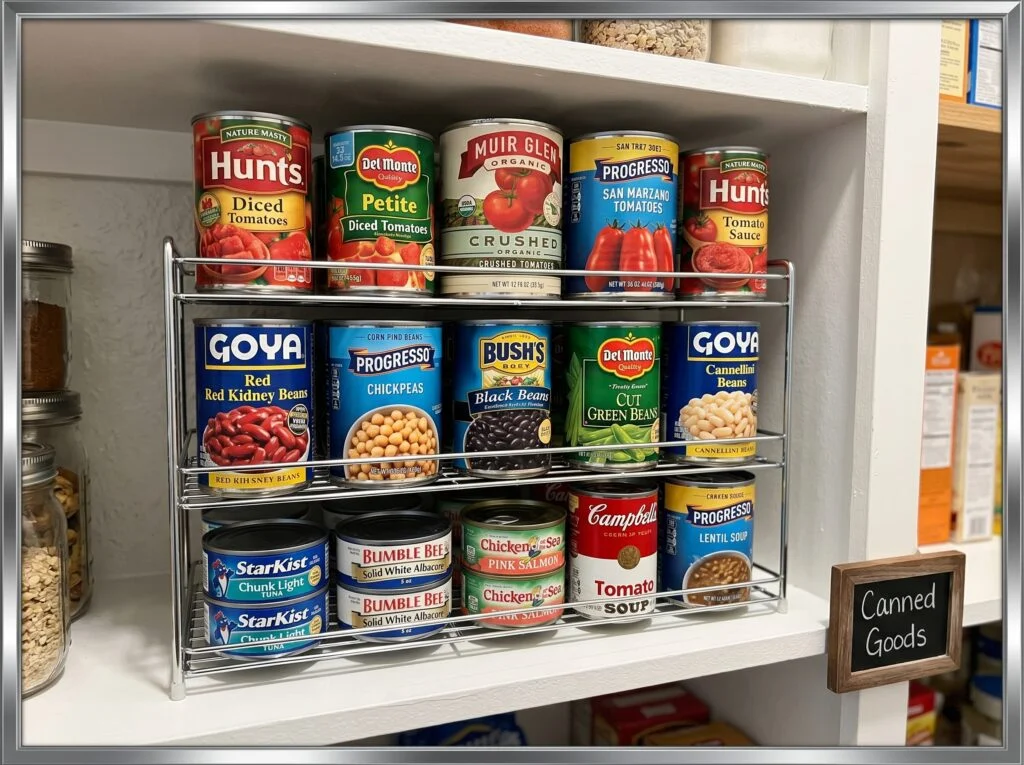
Canned goods are one of the trickiest pantry storage challenges. Stacking cans directly on a shelf means the cans in back are invisible until everything in front gets moved. A tiered can rack solves this by elevating each row slightly above the one in front, so every single label faces you at once.It’s a simple solution that makes a significant difference in how efficiently you use your pantry.
Tiered can racks come in two main styles: stepped stationary racks (fixed risers that sit on the shelf) and rolling can dispensers (cans load from the back, roll forward as you remove them). The rolling dispenser is the more organized option if you regularly buy the same canned items in bulk it creates a natural FIFO (first in, first out) rotation so older cans always get used first.
Labeled Woven Baskets for Loose Items
Labeled woven baskets for loose items add both style and organization to kitchen storage areas. They provide a practical way to group snacks, linens, and everyday essentials while bringing natural texture and a warm, farmhouse-inspired touch to shelves and cabinets.
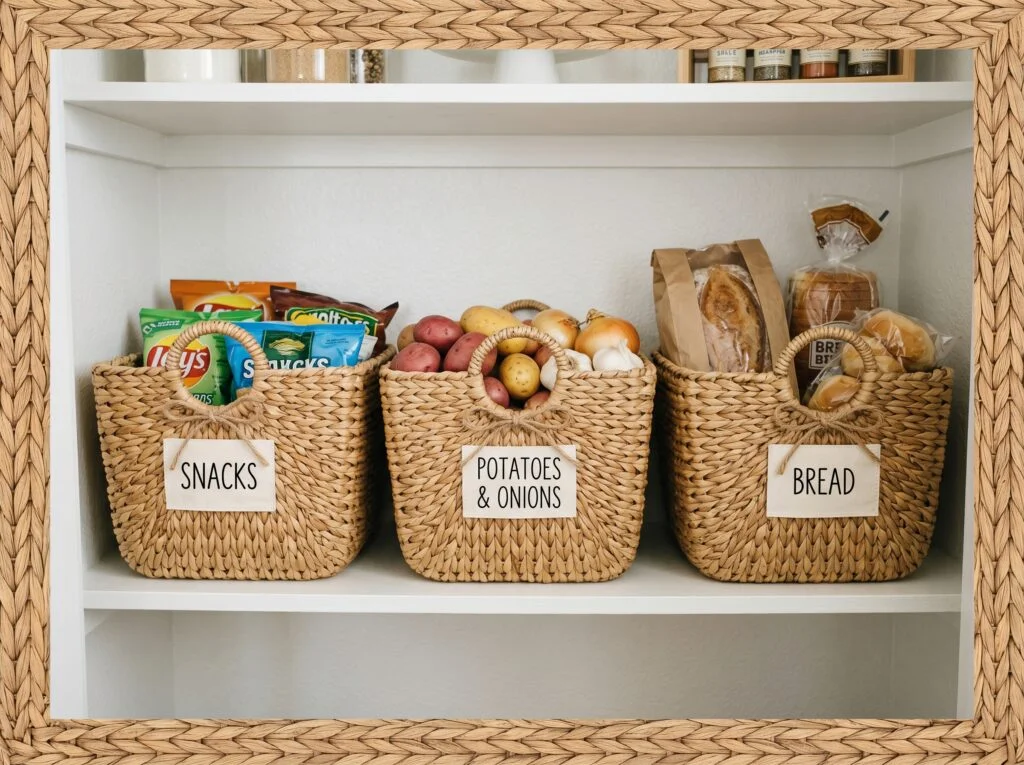
Woven baskets are the most practical pantry storage solution for items that don’t fit neatly into containers or cans snacks, bread, fresh produce like potatoes and onions, root vegetables, bags of chips, loose packets, and anything with an awkward shape. A labeled basket contains the visual chaos of these irregularly shaped items while keeping them instantly accessible.
Choose baskets in a consistent style for a cohesive look seagrass, rattan, and water hyacinth all work beautifully and are durable enough for pantry use. Natural materials also allow airflow, which is important for produce like potatoes and onions that need ventilation to stay fresh. Size baskets to match the shelf depth a basket that’s too shallow for the shelf depth wastes space; one that’s too deep gets items lost in the back.
Adjustable Shelving System for a Walk-In Pantry
An adjustable shelving system for a walk-in pantry provides flexible storage that adapts to changing needs and different item sizes. Customizable shelves help maximize vertical space, improve organization, and create a functional pantry layout where everything stays easy to find and access.
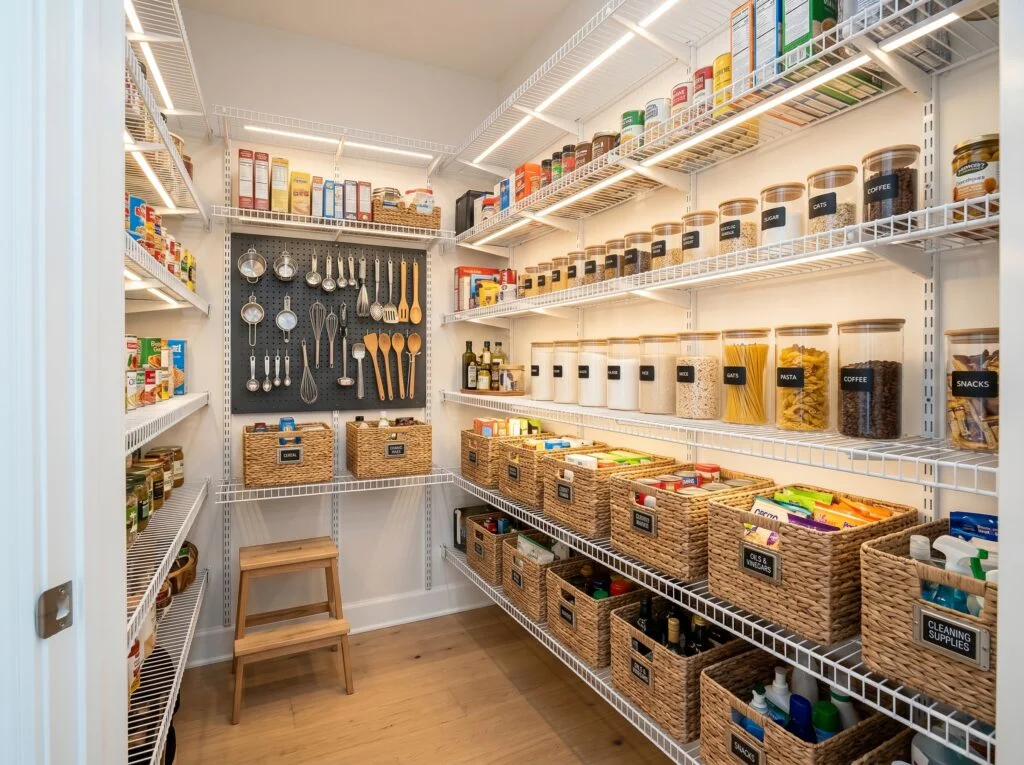
A walk-in pantry with fixed shelves is a missed opportunity. Adjustable shelving systems where shelf heights can be moved up or down as your storage needs change are dramatically more useful over the long term. The items you store in a pantry change with your family’s habits, the seasons, and your cooking style. Adjustable shelves let the pantry adapt to your life instead of forcing you to adapt to it.
The best adjustable systems for walk-in pantries use wall-mounted standards (vertical metal tracks) and bracket-mounted shelves that click in at any height. Wire shelves allow light to pass through from level to level, preventing the dark cave effect that solid shelves create.
If you’re planning around an odd-shaped room, a fully custom walk-in layout might solve more problems than shelving alone.
Pull-Out Drawer System for Snacks and Packets
A pull-out drawer system for snacks and packets keeps small food items organized, accessible, and easy to see. The sliding design makes use of narrow pantry spaces while preventing clutter and helping you quickly find everyday essentials.
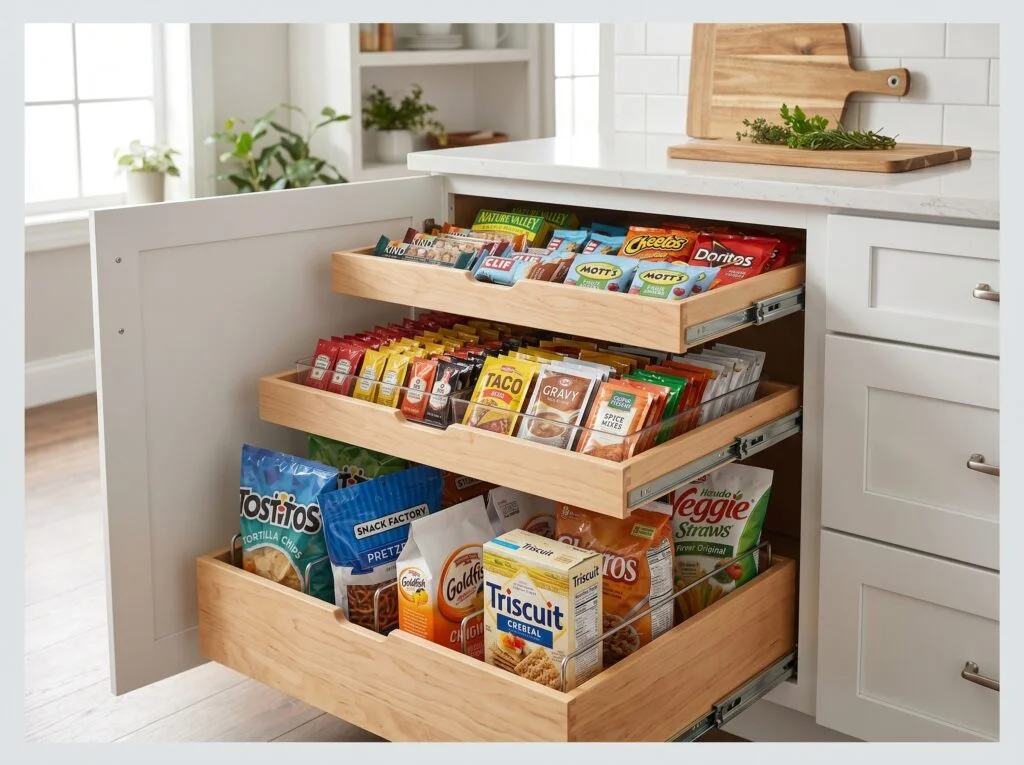
Snack storage is one of the most disorganized areas in most pantries because snack items are all different shapes and sizes and tend to pile up chaotically in a single overcrowded section. Pull-out drawers dedicated to snack storage change the game. Unlike shelves where items get stacked and the bottom layer becomes inaccessible, drawers give you full visibility and full access to everything in the drawer from above. A quick look in the snack drawer tells you exactly what’s available and what needs restocking no digging, no frustration.
Organize the drawers by subcategory: one drawer for individually wrapped snacks and granola bars, one for seasoning packets and sauce packets, one for larger bags of chips or trail mix. Use shallow organizer trays inside the drawer to create sections within each category this prevents items from sliding around every time the drawer opens. For the seasoning packet section in particular, standing packets upright in a small organizer tray like a little file system is transformative you can read every label in a single glance. This system is especially valuable for families with kids who need to find snacks independently without pulling apart the entire pantry.
Pegboard Wall for Hanging Pantry Tools
A pegboard wall for hanging pantry tools creates a flexible storage solution that keeps kitchen essentials organized and within easy reach. Its customizable layout allows you to arrange baskets, hooks, and shelves while making the most of unused wall space.
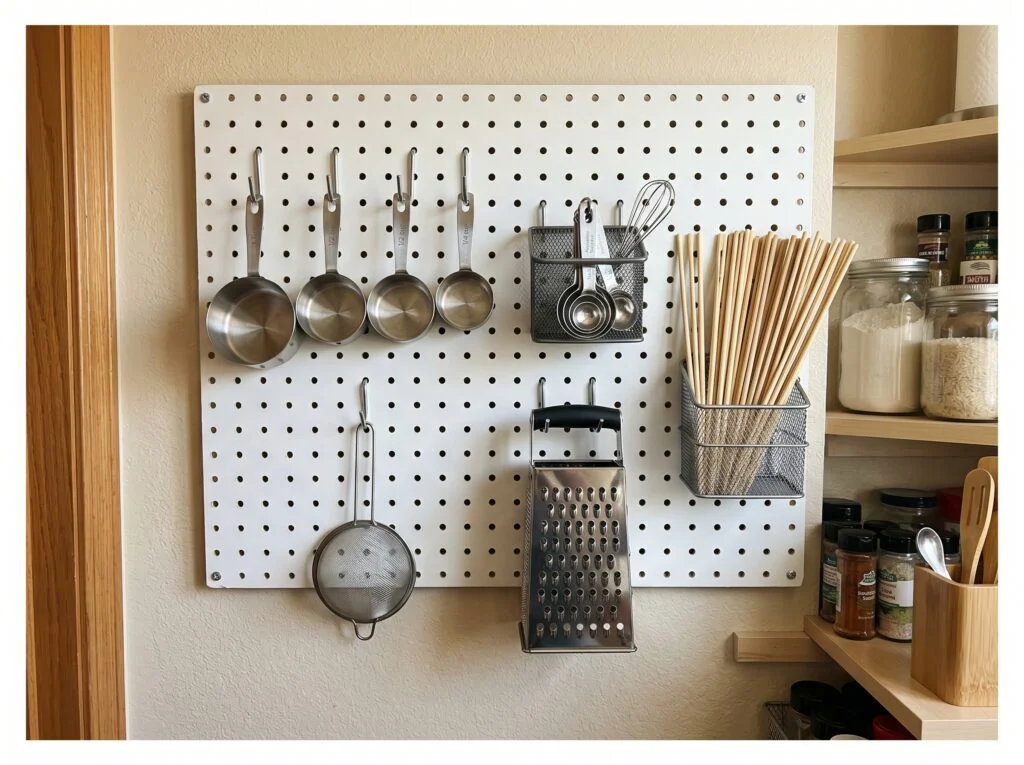
A pegboard inside a pantry or on the wall beside it is one of the most underused kitchen storage strategies, and it’s brilliant for tools, small equipment, and the miscellaneous items that don’t belong on a shelf but have no permanent home. Measuring cups, measuring spoons, a small hand grater, a timer, kitchen twine, skewers, small strainers, and a dozen other frequently used but difficult-to-store items all find a dedicated hook on a pegboard. Everything is visible, accessible, and off the shelves and drawers where they’d otherwise create clutter.
A 2×3-foot pegboard panel fits on most pantry side walls or the back wall of a shallow cabinet pantry. Paint it to match the pantry interior (white is the most common choice) and it looks intentional rather than utilitarian. Use metal pegboard hooks in various shapes straight hooks for handles, J-shaped hooks for cup edges, small wire baskets for loose items. The beauty of pegboard is that you can rearrange the hooks at any time as your storage needs change move a hook a row up or left and the whole system adapts in seconds. Add a small chalkboard at one end for a shopping list or quick notes and the pegboard pulls double duty.
For shelves outside the pantry too, open shelving that stays functional is worth a look.
Turntable Lazy Susans for Corner and Deep Shelves
Turntable lazy Susans for corner and deep shelves make hard-to-reach storage areas more functional and organized. Their rotating design allows easy access to spices, jars, and pantry items while maximizing space and reducing the frustration of searching through cluttered shelves.
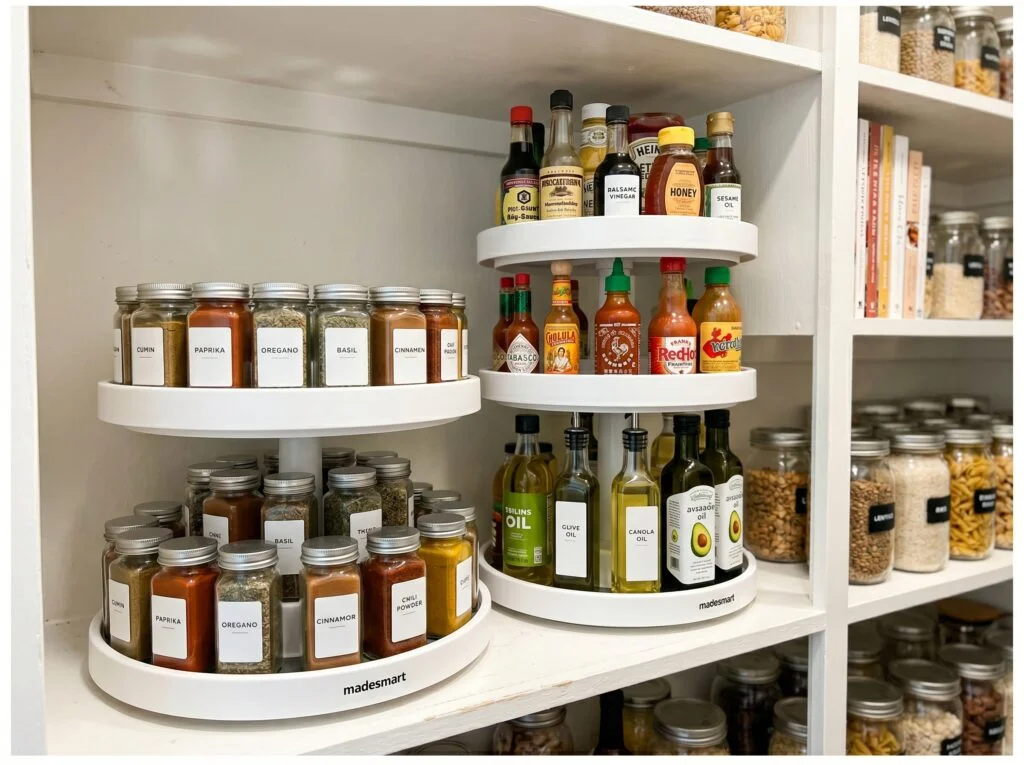
Lazy Susans are one of the most effective pantry storage tools available, and they’re significantly underused. In corner cabinets and deep shelves where reaching the back is difficult, a turntable brings everything to the front with one simple spin. Nothing gets lost at the back. Nothing expires unnoticed. You use up what you have because everything is equally visible and accessible.
Place lazy Susans in the areas where access is hardest: corner shelves, the backs of deep shelves, and the section of shelf where you store cooking oils, vinegars, and condiments. Choose a version with raised edges to prevent jars from spinning off and falling. White turntables look clean against white shelving; bamboo or acacia wood versions look warmer and work beautifully in rustic or farmhouse pantry aesthetics.
Vertical Dividers for Baking Sheets and Cutting Boards
Vertical dividers for baking sheets and cutting boards create a smart storage solution that keeps large kitchen items neatly arranged and easy to access. By storing trays upright, they save cabinet space, prevent clutter, and make cooking essentials more organized.
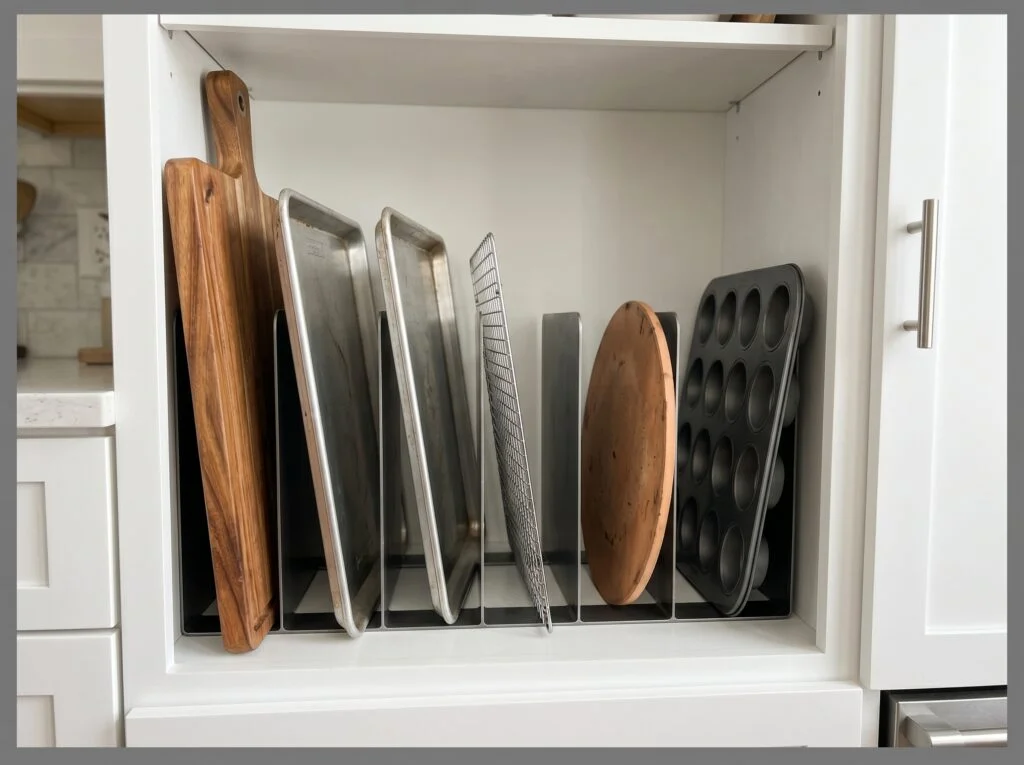
Baking sheets, cutting boards, cooling racks, and muffin pans are among the most awkward pantry storage challenges in any kitchen. When stacked flat, every item needs to be lifted off to access the one at the bottom. They scratch each other, they take up enormous shelf space, and retrieving a single sheet pan from the middle of a flat stack is quietly infuriating.
Install vertical dividers in a lower cabinet base section this is the ideal location because baking sheets and cutting boards are heavy and awkward to carry from a high shelf. Metal wire dividers or solid wood dividers both work well; metal is more durable and allows airflow to prevent moisture buildup. Space the slots about 1.5 to 2 inches apart so items slide in and out without binding but don’t have enough room to fall sideways.
Under-Shelf Hanging Baskets for Vertical Space
Under-shelf hanging baskets for vertical space provide an easy way to add extra storage without taking up valuable shelf area. They are perfect for organizing small pantry items, snacks, and kitchen essentials while maximizing unused space and keeping shelves tidy.
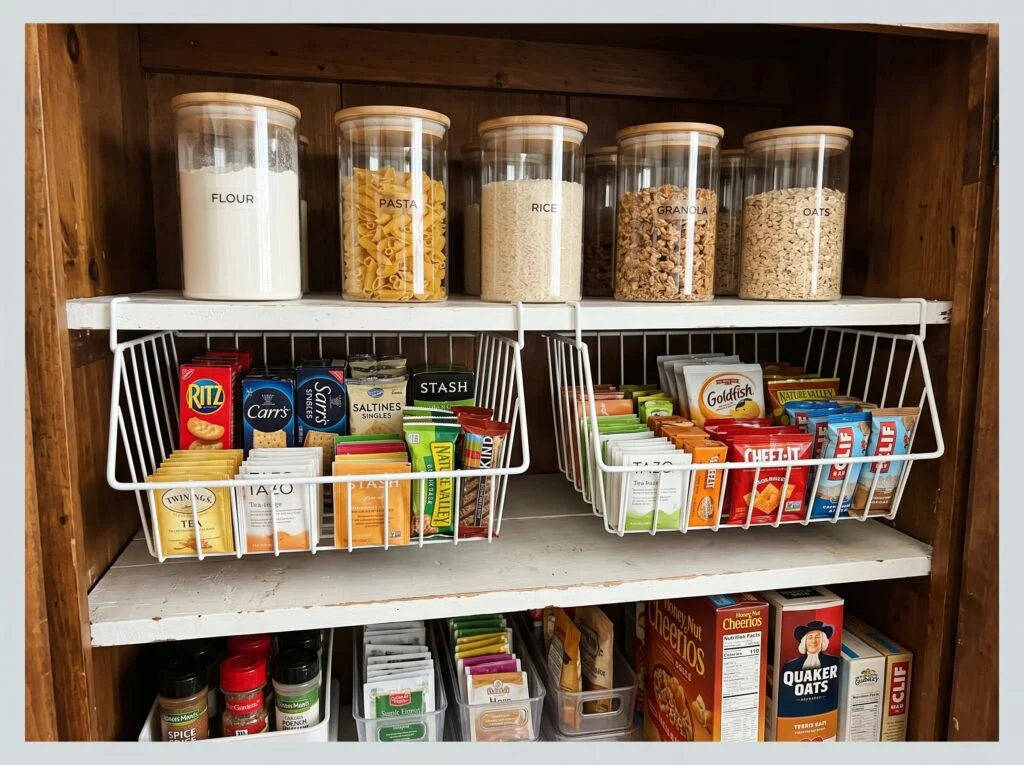
Under-shelf hanging baskets are a small investment with a disproportionately large payoff. They clip or slide onto the underside of an existing shelf and create a second storage zone in the same vertical space essentially doubling the capacity of that shelf level for small, lightweight items. Most pantries have several shelves with 12 to 14 inches of clearance between them, and most items on those shelves don’t use more than 4 to 6 inches of that height. The space between the top of your items and the shelf above is genuinely wasted under-shelf baskets reclaim it
These baskets work best for lightweight items: individual snack pouches, tea bags, seasoning packets, small boxes of crackers, packets of instant oatmeal, or plastic wrap and foil boxes. Avoid overloading them they’re designed for lightweight items, and too much weight can bend the shelf above over time. Choose wire baskets over solid ones so the contents are visible without opening or lifting anything. They’re available at virtually every home organization store and on Amazon for $8 to $20 for a pack of two. Install them on the shelves with the most vertical dead space usually the upper shelves where shorter items sit beneath taller clearances.
Pantry Lighting: LED Strip Lights Under Each Shelf
Pantry lighting with LED strip lights under each shelf improves visibility while adding a modern, organized feel to storage spaces. The layered illumination makes it easier to find ingredients, reduces dark corners, and creates a clean, functional pantry setup.
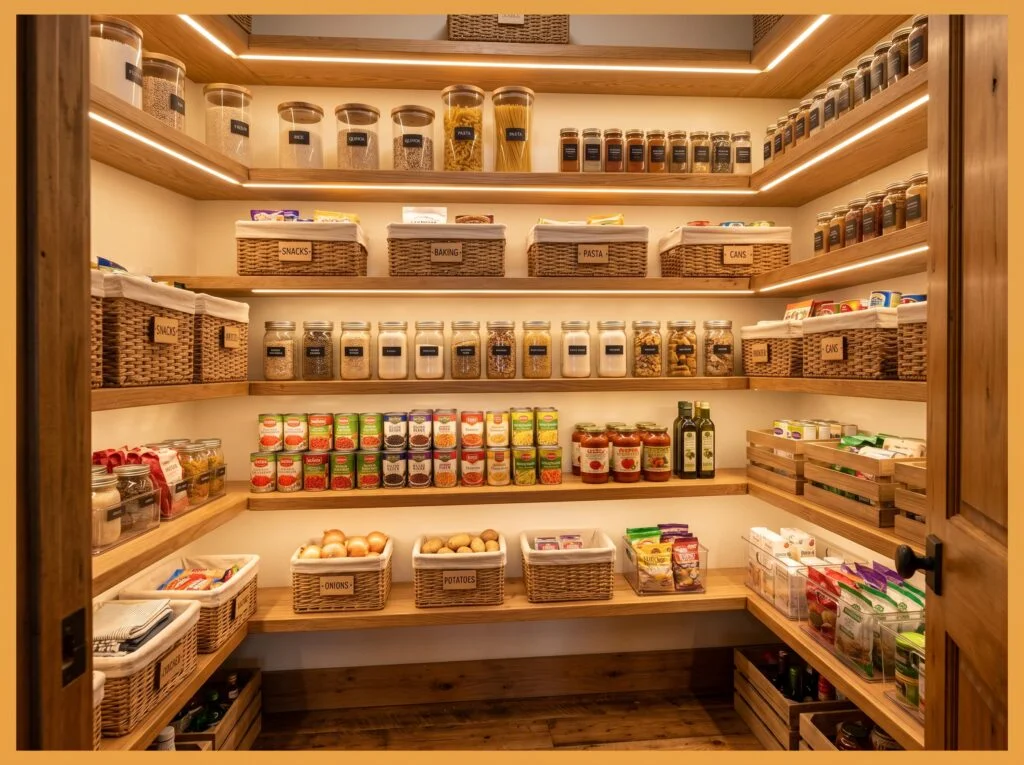
This is the one kitchen pantry storage idea that almost every article completely ignores and it changes everything. A pantry without good lighting is a pantry where things get lost. A single overhead bulb casts harsh shadows under each shelf, leaving the contents in partial darkness. LED strip lights mounted to the underside of every shelf eliminate shadows entirely by lighting each shelf from directly above the items on it. Every label is readable. Every jar color is distinguishable. Finding what you need takes seconds instead of minutes.
Plug-in LED strip lights with an adhesive backing are the easiest version no wiring required, no electrician needed. Mount the strip toward the front edge of the shelf underside for maximum forward illumination onto the shelf below. Use warm white (2700K to 3000K) for a cozy, inviting pantry feel, or neutral white (4000K) if you prefer a cleaner, more clinical look.
Magazine File Holders for Foil, Bags, and Wrap
Magazine file holders for foil, bags, and wrap provide a simple way to organize kitchen essentials while saving drawer and cabinet space. Their vertical design keeps rolls neatly stored, easily accessible, and prevents clutter in busy pantry or kitchen areas.
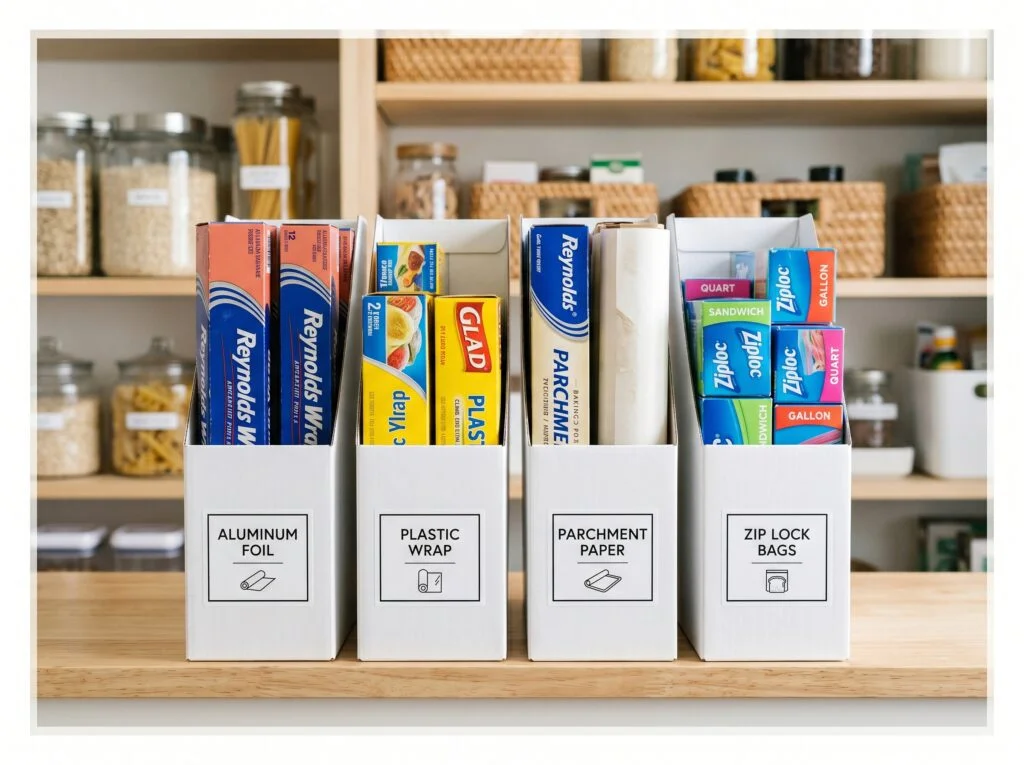
Aluminum foil, plastic wrap, parchment paper, wax paper, and zip-lock bags of various sizes are universally awkward to store. They’re too tall for most drawers, they don’t stack well on shelves, and they tend to tip over, unravel, or fall behind other items. Magazine file holders the simple cardboard or plastic upright organizers normally used for papers are the unexpected solution that works perfectly for all of these items. Stand each box upright in its own labeled file holder and you can pull out exactly what you need in one motion, with the rest staying upright and organized.
Use matching file holders for a cohesive look white metal, white cardboard, or clear acrylic all work well on pantry shelves. Label each one with a small adhesive label or a strip of washi tape and a handwritten note. Keep this section at eye level or slightly below since you use these items frequently during cooking. This system also works for small appliance manuals, recipe cards, and takeout menus anything flat and paper-based that would otherwise pile up in a kitchen junk drawer.
Clear Stackable Bins with Labels by Category
Clear stackable bins with labels by category create an efficient pantry organization system by keeping items visible, grouped, and easy to find. Their space-saving design maximizes storage while helping maintain a clean, tidy, and functional kitchen setup.
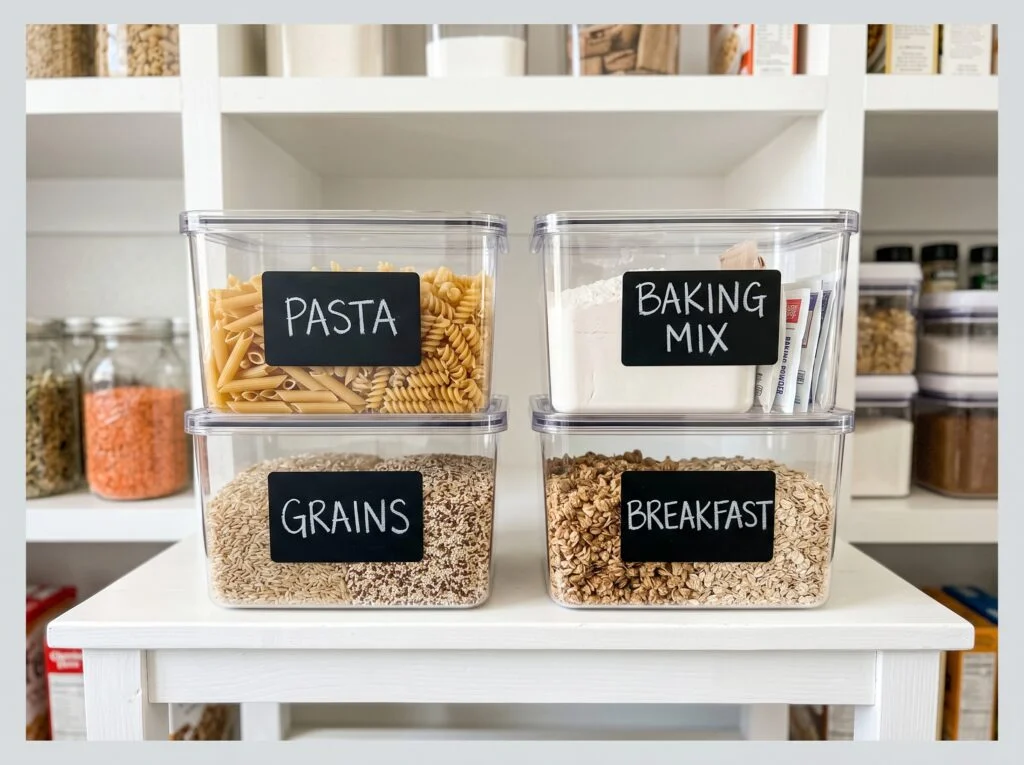
Clear stackable bins are the workhorse of pantry organization they contain loose items, make everything visible, and maximize vertical shelf space by stacking cleanly. Where individual items or oddly shaped packages would sprawl across an entire shelf, a bin corrals an entire category into one neat footprint. A “Pasta” bin holds every pasta shape you own. A “Baking Mix” bin holds the brownie mix, the pancake mix, and the muffin packets.
Choose bins with slightly tapered sides so they stack stably and pull out easily without catching on the shelf or the bin below. The Container Store’s Linus bins, IKEA SAMLA containers, and Amazon Basics clear stackable bins are all excellent options at different price points. Label the front face of each bin not the top so the label is readable whether the bin is on the bottom of a stack or at eye level. A label maker with a bold font produces the cleanest result; handwritten labels on chalkboard stickers have a warmer, more personal look.
Pantry Storage for a Small Kitchen (No Walk-In Required)
Pantry storage for a small kitchen focuses on smart organization solutions that maximize every inch of available space. Using vertical storage, compact containers, and creative shelving ideas helps create a functional pantry system without needing a dedicated walk-in area.
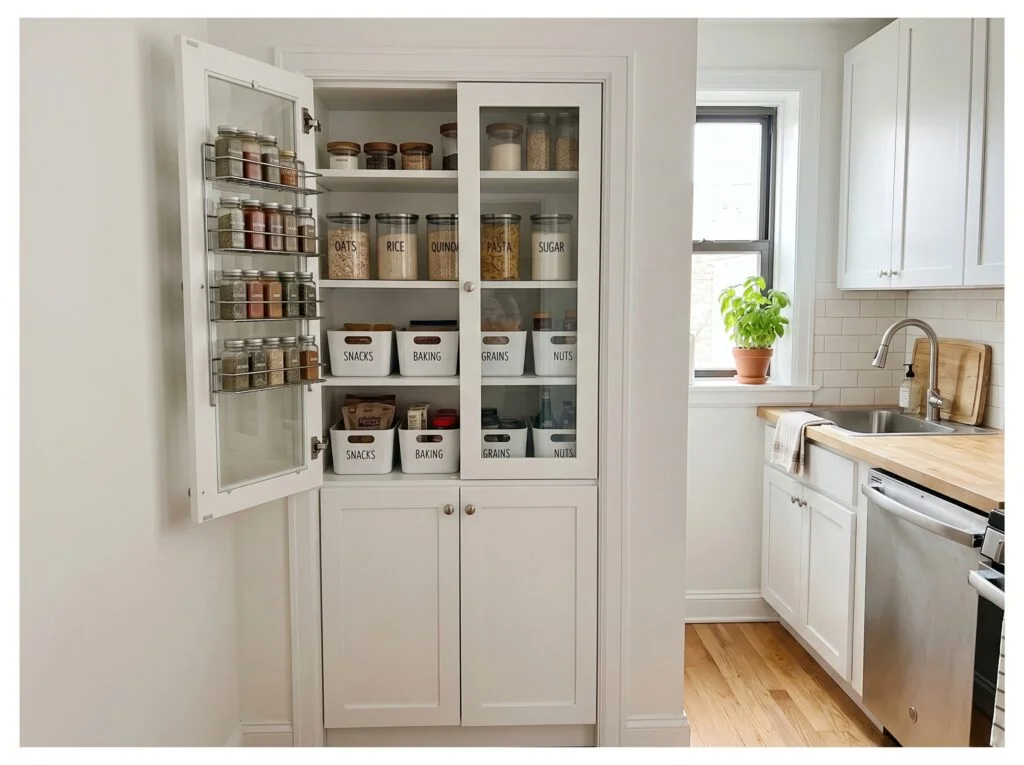
Most kitchen pantry inspiration photos show large, beautifully lit walk-in pantries which is genuinely unhelpful for the majority of people who are working with a single cabinet, a closet converted to pantry use, or no dedicated pantry space at all. Small kitchen pantry storage requires a completely different strategy: vertical maximization, door utilization, and ruthless editing of what lives in the pantry versus elsewhere. The good news is that a well-organized small pantry functions significantly better than a large disorganized one. Size matters less than system.
For a single cabinet pantry, use every inch deliberately. Install an over-door organizer for spices and small items. Use pull-out shelves for the lower deep section. Stack clear bins vertically to double each shelf’s capacity. Dedicate one shelf entirely to baking and one entirely to canned goods category discipline prevents the mixing that makes small pantries feel chaotic. If you have a closet you can convert, install adjustable shelving on all three walls, add a pegboard panel on the back wall, and use the floor for large items and appliances. A well-executed 24-inch-wide closet pantry can hold as much as many walk-in pantries because every surface gets used intentionally.
If your whole kitchen runs small, there are more tricks for working with tight cabinets throughout the space.
The Labeling System That Actually Keeps Your Pantry Organized
The labeling system that actually keeps your pantry organized uses clear categories, consistent labels, and designated storage zones for everyday items. A simple approach makes ingredients easier to find, reduces clutter, and helps maintain a neat pantry long after organizing.
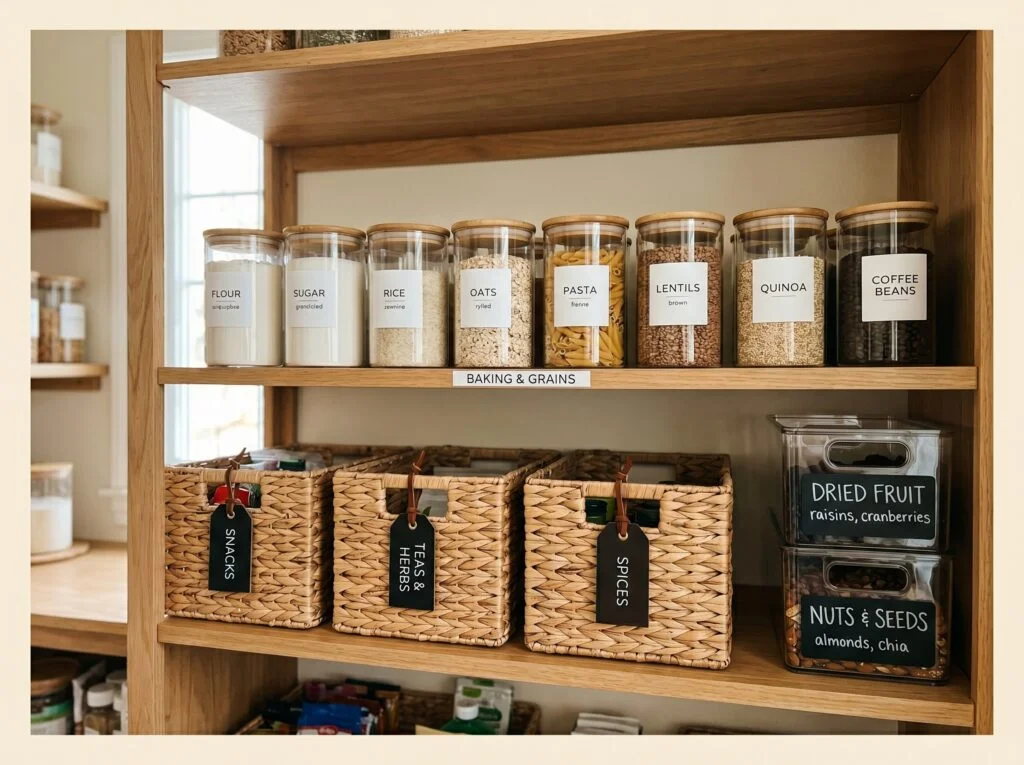
The label is the final step that makes every other pantry system actually work long-term. Without labels, an organized pantry slowly reverts to chaos because people including you can’t remember which bin holds which category, which jar holds which grain, or where the snack section starts and the baking section ends. Labels are the instruction manual that lives in the pantry. They communicate the system to everyone in the household so things go back where they belong without a reminder. A labeled pantry stays organized. An unlabeled pantry doesn’t, regardless of how well it was set up initially.
Choose a labeling style that’s consistent across the entire pantry. A label maker (the Brother P-Touch is the most popular recommendation among professional organizers) produces clean, uniform text that looks professional and lasts for years. Handwritten labels on chalkboard stickers have a warmer aesthetic that works beautifully in farmhouse or cottage kitchens. Leather hang tags tied with twine work on woven baskets. Whatever style you choose, use it exclusively mixing multiple label styles in one pantry creates visual noise that undermines the organized look you’ve worked to create. Label containers with the food name AND the category (e.g., “Pasta Dinner Staples”) so restocking is clear even for a family member who didn’t set up the system.
The same labeling discipline works well beyond the pantry too, especially with countertop styling that stays organized.
Conclusion
An organized pantry isn’t about aesthetics though it does look incredible. It’s about function. It’s about knowing exactly what you have, using what you buy before it expires, and making cooking faster and less stressful every single day.
Start with the three ideas that will make the biggest immediate difference in your specific pantry.
You don’t need a walk-in pantry or an expensive renovation. You need a clear system, the right organizers for your space, and labels that communicate the system to everyone who uses it. Do those three things and your pantry will stay organized for years not just for the weekend after you set it up.
And if you’re looking to extend that same organized feeling further, an island layout with real storage is a natural next step.